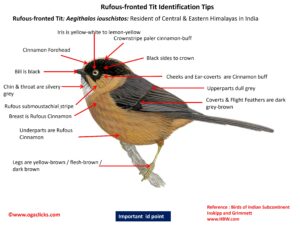
Rufous-fronted Tit Aegithalos iouschistos
Etymology:
- Aegithalos : Greek word for Tit
- Iouschistos : Greek word ioeis – dark; Latin Word schistus – slate
Sub Species :
- Aegithalos iouschistos bonvaloti : Resident of extreme North east Arunachal Pradesh ( Walong)
Distribution : Resident of North East India (North West Arunachal Pradesh)
Description: It has size of 11 cm; weight of 6–7·5 g. It is a typical long-tailed tit in size and shape, with well-graduated long tail. It has forehead and centre of nape as cinnamon, broad crownstripe paler cinnamon-buff, side of crown are glossy black, grading to black on lores and upper ear-coverts. The lower ear-coverts, cheek and side of neck are cinnamon-buff, narrow rufous submoustachial stripe extending to side of breast. The upperparts dull mid-grey, slightly pinker on rump. The greater upperwing-coverts and flight-feathers are dark grey-brown, fringed medium grey, tail is dark grey-brown, outer three feather pairs tipped paler. The chin and side of throat black form a diffuse inverted “V”, center of throat and breast silvery grey, remainder of underparts rufous-cinnamon. The iris is yellow-white to lemon-yellow; bill is black; legs are yellow-brown or flesh-brown to dark brown. Differs from Black-throated Tit in having much more extensive blackish on side of head, pale crownstripe, lack of white supercilium and lack of black bib.
Both the sexes are alike. The juvenile has a crownstripe paler, side of head is duller black, submoustachial stripe and ear-coverts are pale pinkish-buff, side of neck and entire underside and throat are dirty pale buff, more cinnamon-buff on belly and vent, with dark grey blotching and spotting, especially on breast.
Habitat: It is found in forest edges, clearings and scrubby growth in and around temperate forest of oak, rhododendron and chestnut, also mixed forest and stands of pine, spruce or hemlock at higher altitudes and scrub above tree-line, especially riverine scrub. The altitudinal range in Himalayas is 2200–3770 m, , but only occasionally moves lower in winter below 3200 m.
Food habits: It eats insects, including their eggs and larvae; also, some vegetable matter. It forages in canopy, as well as in shrub layer. It occurs in parties of up to 40 individuals outside breeding season, sometimes joining mixed-species foraging flocks.
Breeding habits: They breed in Mar–Jul. The nest is ball shaped, entrance hole to side, studded outside with lichens and lined with feathers, placed in a tree.