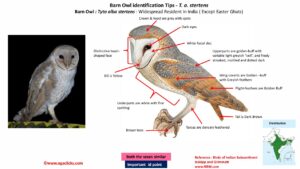
Barn Owl Tyto alba stertens
Etymology :
- Tyto : Greek word for Owl derived from tuto
- Alba : Latin word for White
- Stertens : Latin word stertentis – snorer
Vernacular Names : Hindi: Kuraya, Karail ullu, Buri churi, Kash: Rata mogul, Pun: Sunahiri ulloo, Bi: Madoosa, M.P.: Ghughu, Ben: Lakshmi pecha, Guj: Revi devi, Mar: Gavhani Ghubad, Ori: Lakshmi pecha, Ta: Chavu kuruvi, Te: Chavu pitta, Mal: Veli munga, Kan: Goobe, Sinh: Bakamuna
Distribution in India: Widespread Resident in India.
Description: Size of male 510–650 g, female 530–690 g. It is a medium-sized, long-legged owl with distinctive heart-shaped face. The nominate race is golden-buff above, with variable light greyish “veil”, and finely streaked, mottled and dotted dark. The white facial disc and underparts, have pale buff on sides of chest and fine spotting on breast and flanks. The legs are densely feathered; eyes are dark. It has a buoyant, slow, wavering flight, with legs dangling, appears ghost-like. Both the sexes are similar, but female tends to be slightly darker than male. The juvenile is similar to adult, but more heavily spotted. Racial variation is considerable, from light grey to buff above and from white to buff below, with varying amount of black spotting and speckling, but widespread intergradation. Race stertens is pale and greyish above, with small spots on pale underparts.
Habitat: It occurs in great variety of habitats according to availability of prey, seasonality in temperate regions, and competition from other predators; in higher latitudes limited by severity of winters. It prefers open lowlands with some trees, including farmland with hedges, ditches, ponds and banks, roadside verges and related rougher terrain, and young conifer plantations; also around towns, suburbs, villages or more isolated buildings suitable for daytime roosts and nest-sites; sometimes near refuse dumps. In lower latitudes, also semi-arid and some arid regions .It is found from lowlands up to 4000 m.
Food Habits: They primarily eat small mammals like rats and shrews, rabbits, small birds, geckos and lizards. It hunts close to ground in searching flight, undulating and hovering, diving on to prey with talons extended also commonly from perch. It is strictly nocturnal, with high auditory acuity in locating prey in complete absence of moonlight.
Breeding Habits: They are double-brooded mostly Mar–May and Jun–Aug correlated with cycles of prey abundance. The nest site is a natural cavity in tree trunk, stump or large hollow branch above ground, or in cliff or bank, including sea-cliffs and small, exposed islands, in cave, walls of lava tubes, even in ground; also in hollow of palm tree; wide diversity of artificial structures with adequate room and access also used like bridges and other large structures, lighthouse, chimney and other human-made structures . They lay a clutch of 2–16 eggs, if the first clutch is lost, the replacement clutch is usually smaller. The nestling period is 7–10 weeks. The young are dependent on parents for further 3–5 weeks, then disperse within 2–8 weeks.