Besra Tachyspiza virgatus
Etymology :
- Tachyspiza : Greek word : takhus -: fast; spizias-: hawk
- Virgatus: Latin word for “striped, streaked” derived from virga – streak
- Affinis : Latin word for related, allied, neighbourly
- Besra: Hindi name Besra for the female Besra (the male is known as Dhoti)
- Abdulalii : Humayun Abdulali (1914-2001) Indian ornithologist
Vernacular Names : Hindi: Besra(F), Dhooti(M), Khand besra, Guj: Besra, Besra shakro, Ta: Chinna valluru, Te: Vaishtapa dega, Kan: Urchitlu, Sinh: Ukussa, Kurulla goya, Mar: Besara Chimanmar Sasana
Distribution in India:
- v. affinis – Kashmir and North India
- v. besra – South & West India
- v. abdulalii– Andaman Islands
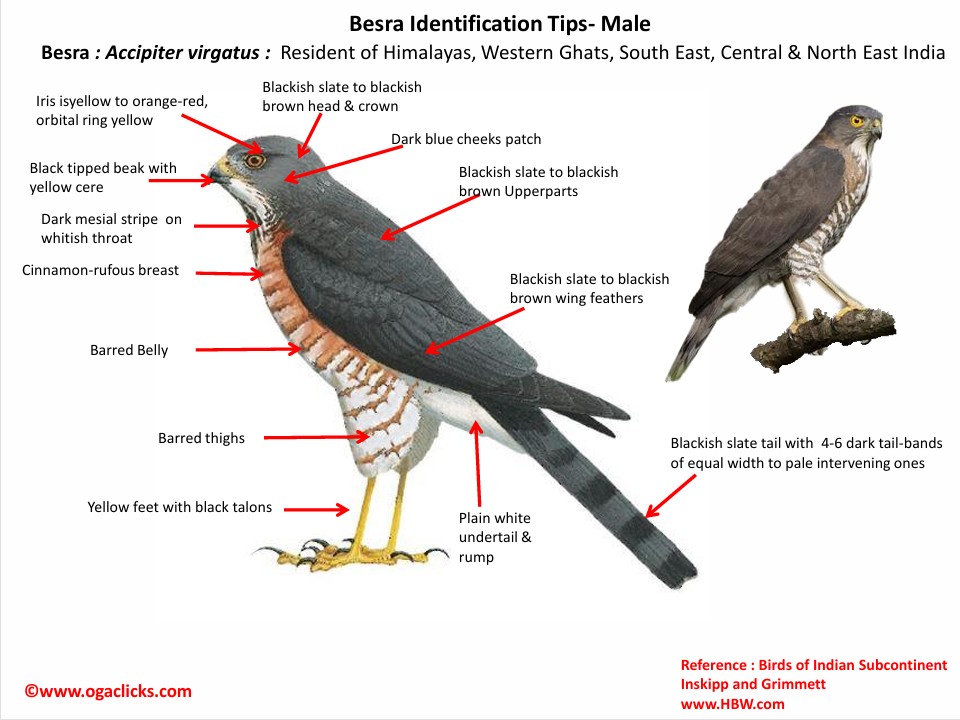
Description: It has a size of 24–36 cm; Wt. of males is 83–99 g , females weigh 190–215 g ; wingspan of 42–58 cm for male and 56–70 cm for female. It is a small Sparrowhawk with smallish bill and head, rounded wings, dark mesial stripe on whitish throat, and four to six dark tail-bands of equal width to pale intervening ones. The male is blackish slate to blackish brown above, with dark blue cheeks patch, cinnamon-rufous breast and flanks, barred belly and thighs and unmarked white undertail coverts.
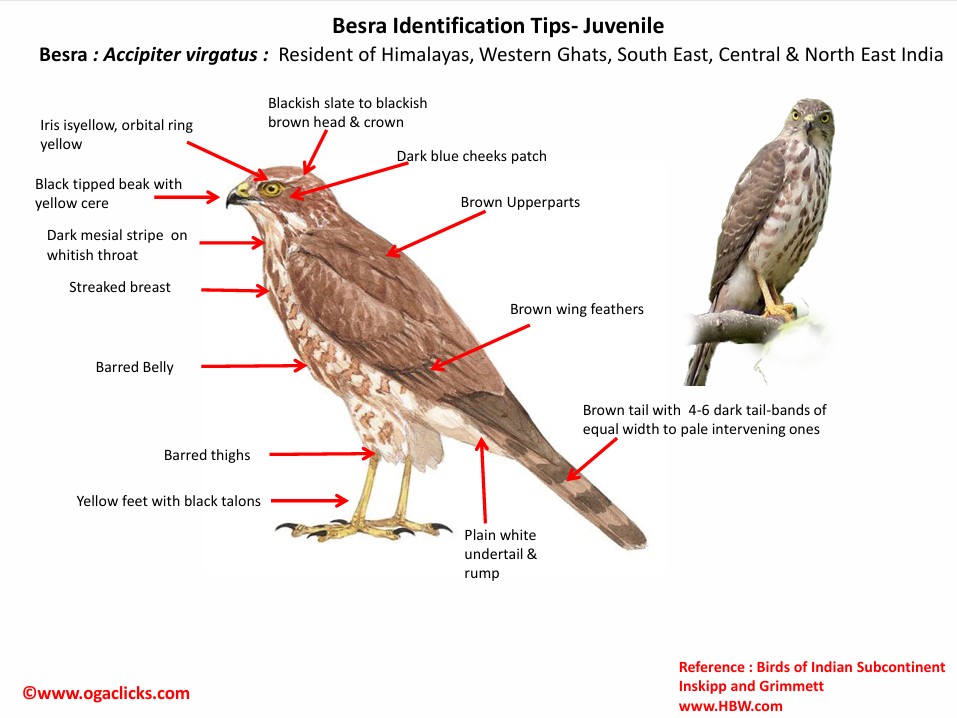
The female averages 15–25% larger than male and is browner on back, with on average paler eye; irides are yellow to orange-red, orbital ring is yellow, cere is greenish-grey to yellow, feet is yellow. The juvenile is brown above, pale below with streaked breast and barred flanks and belly; irides are greenish-grey to yellow.
The races differ primarily in size; smaller on islands than mainland and colour intensity.
The race affinis is the largest and relatively longest winged; abdulalii is small
Habitat : It is found in wide variety of forests, deciduous and evergreen montane forest, secondary forest, plantations, mangroves and pine forest. It occurs from sea-level to 3400 m.
Food habits: It eats birds, insects and lizards. It feeds with quick agile chase of birds launched from inconspicuous perch. The prey is taken in air like birds and to lesser extent on ground and in trees like lizards, small mammals, insects. It is often seen perched on tall dead tree in forest.
Breeding habits: They breed in Jan–Jun in South India and Sri Lanka; Mar–Jun in North India. The nest is made of twigs lined with green leaves built by the pair above ground in large tree in forest. The nest-tree often situated on precipice overlooking ravine. They lay a clutch of 3–4 eggs. The incubation period is 28 days. The nestling period is 22–23 days. The young disperse 4 weeks after fledging.