Black-breasted Weaver / Bengal Weaver Ploceus benghalensis
Etymology:
- Ploceus : Greek word plokeus – weaver, braider, plaiter derived from pleko – to plait, to entwine
- Benghalensis: From Bengal in India
Distribution : Resident of North India (mainly in Ganges floodplain from Punjab East to West Bengal and Assam)
Description : It has a size of 15 cm; weight of 18–22 g.
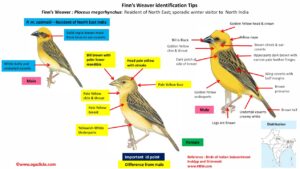
The male in breeding plumage has forehead and crown as golden-yellow. The nape to back is dark brown, mantle with some pale feather fringes, rump is light brown. The upperwing and tail are dark brown, wing-coverts are with paler edges. The lores, cheek, ear-coverts and chin are chocolate-brown, throat is grey-brown, variable, some have white chin and throat and may also have cheeks and ear-coverts completely white. The breast is dark brown as broad, clearly defined band. The belly, flanks, thighs and undertail-coverts are creamy white, some streaking on flanks. The iris is dark brown; bill is bluish-grey; legs are pale brown.
The male in non-breeding lacks golden crown, has top of head as blackish, yellowish supercilium and submoustachial stripe, dark line through eye and dark line around ear-coverts; extent of black breastband variable, often restricted to patch at each side.
The female has forehead, crown and nape grey-brown with darker streaks, mantle and back feathers are brown with very broad central streaks, rump is light brown, wings and tail are dark brown; yellow supercilium, greyish lores, darker grey-brown postocular stripe becoming a narrow dark border between greyish ear-coverts and yellow patch on side of neck. The cheek is a mess of yellowish and off-white feathers, short dark grey-brown moustachial stripe, yellow submoustachial area to chin and upper throat becoming pale cream on lower throat, sometimes with narrow, short dark malar stripe. The breast may have solid dark band, broken dark-speckled pattern, or a dark patches at each side; center of belly and undertail-coverts are creamy white, flanks and thighs are buffy with faint streaks; bill is brown or horn-grey above, paler horn-grey or pale flesh-coloured below.
The juvenile resembles female, but broad white supercilium may continue onto nape.
Habitat: It is found in lowland grassy areas near water, with tall standing grass and reeds; primarily in areas subject to periodic flooding.
Food habits: It eats seeds, rice, wheat, millet and sorghum. The young are fed primarily with animal food, insects, grasshoppers, caterpillars, beetles, spiders, and small snails. They are gregarious, found in flocks; often forages with and forms mixed roosts starlings and other species.
Breeding habits: They breed in Jun–Oct in India. They are polygynous. They are colonial, often nesting together with other weaver species. The males court with quivering wings, bill pointed downwards and yellow crown maximally exposed. The nest is retort-shaped with entrance tunnel, woven by male from strips of grass or reed blades, suspended above ground from grasses with upper dome directly attached to grass or attached to reeds or bulrushes.
At “helmet” stage, inner rim plastered with cow dung or human faeces (but not mud), and bright yellow flowers and pink flowers, yellow fruit rinds, placed in nests. If the female accepts nest structure, it is then completed, and no decorations added once nest occupied. The deserted nests are used for roosting and breeding by Indian Silverbill and long-tailed tree mouse. They lay a clutch of 3 eggs. The incubation is done by female. The incubation period is 13–15 days. The chicks are fed with insects by female, male contributing during final five days. The nestling period is 15 days.