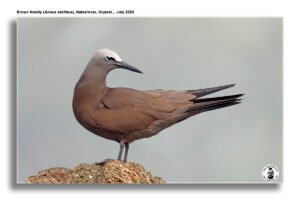
Brown Noddy Anous stolidus
Etymology:
- Anous : Greek word for foolish, silly
- Stolidus : Latin for foolish, stupid
Vernacular Names : Mald: Maranga, Lakshadweep: Karifaid, Mar: Tapakiri dolmanya
Distribution : Breeds in Lakshadweep Islands. Seen in Coastal areas of India
Description : It has a size of 38–45 cm; weight is 150–272 g); wingspan of 75–86 cm.
It is a dark chocolate-brown noddy, with pale grey crown, almost white on forehead. It has narrow incomplete white eye-ring. The upper wing shows slightly paler band across greater coverts; primaries are black, and long wedge-shaped tail is blackish. The iris is dark brown; bill, legs and feet are black or blackish-brown.
The female significantly smaller and lighter in weight than male.
The Juvenile similar to adult, but with brown crown and pale fringes to upperpart feathers.
Habitat: It is found in Pantropical and subtropical islands, often with small populations dispersed throughout many inshore and oceanic islands., inaccessible islands and coral reefs . It nests on cliffs, and offshore stacks ,sometimes on ground or in tree. When resting, settles on buoys, flotsam, ships and even on the sea.
Food habits: It eats fish and squid. It feeds mainly by hover-dipping and contact-dipping; regularly foot-patters at surface, rather than swooping; does not usually plunge-dive. It captures flying-fish in the air. It is often associated with other birds over schools of predatory fish. It forages on moonlit nights.
Breeding habits: They breed in Aug–Oct; . The colonies areb very dense or more open, depending on available ledges. The nest-site is variable, from flat beaches to cliffs, from bare ground to low bushes and tall trees: The nest is made of seaweed and twigs or sticks They lay 1 egg. The incubation period is 28–37 days.