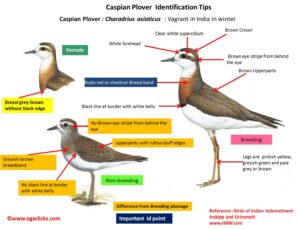
Caspian Plover Charadrius asiaticus
Etymology:
- Charadrius: Greek word kharadrios for unknown plain-coloured nocturnal bird that dwelt in ravines and river valleys
- Asiaticus: From Asia
Vernacular Names : Mar: Caspian Chikhlya
Distribution: Vagrant in India . Usually seen in Tamil Nadu & Kerala Coast
Description: It has a size of 18–20 cm; weight of 60–91 g; wingspan of 55–61 cm. It is a slim, upright plover, with clear white supercilium, forehead and throat; brown crown and upperparts. The breastband is rusty red or chestnut, with black line at border with white belly. It has white flashes on upperwing, underwing-coverts are white; legs vary between pinkish yellow, greyish green and pale grey or brown.
The female has breast grey-brown without black edge; sometimes has a few chestnut feathers tipped white; head and throat less white.
The non-breeding adult has greyish-brown breastband; face, forehead and throat pale buffish, upperparts with rufous-buff edges, when fresh. The Juvenile like non-breeding adult, with clear rufous and buff fringes to upperparts feathers.
Habitat: It breeds in lowland desert and desert steppe, preferably in saltpans or on saline soil, often subject to seasonal flooding, near water among sparse shrub vegetation. During the breeding season recorded between sea-level and 800 m.
Food habits: It eats insects and their larvae. In breeding season mainly eats beetles, also ants, grasshoppers, bugs, caterpillars and fly larvae; occasionally plant material. During the non-breeding season eats beetles, termites and grasshoppers, also small snails. Typical stop-run-peck foraging behaviour, running rapidly, pausing only when prey is located.
Breeding habits: They breed in Apr to late Jun. They form monogamous pair-bond. They are territorial, nesting singly or in small, loose groups of 10–25 pairs. Adults will feed in small flocks outside territory, leaving eggs and young unattended. The nest is a shallow, sparsely lined with plant material and debris, on ground in the open or among low vegetation, typically near water. They lay a clutch of three eggs. They are single-brooded with replacements laid after egg loss. The eggs are incubated by both adults, only female at night. The chick has crown, back and band down leg as pale cream, marked with black spots, forming lines on crown, back and forewings, while forehead, sides of head, hindneck collar and underparts are white. The chicks are tended by both adults. The fledging period is 30 days. The families with young tend to assemble in moist places or river bars.