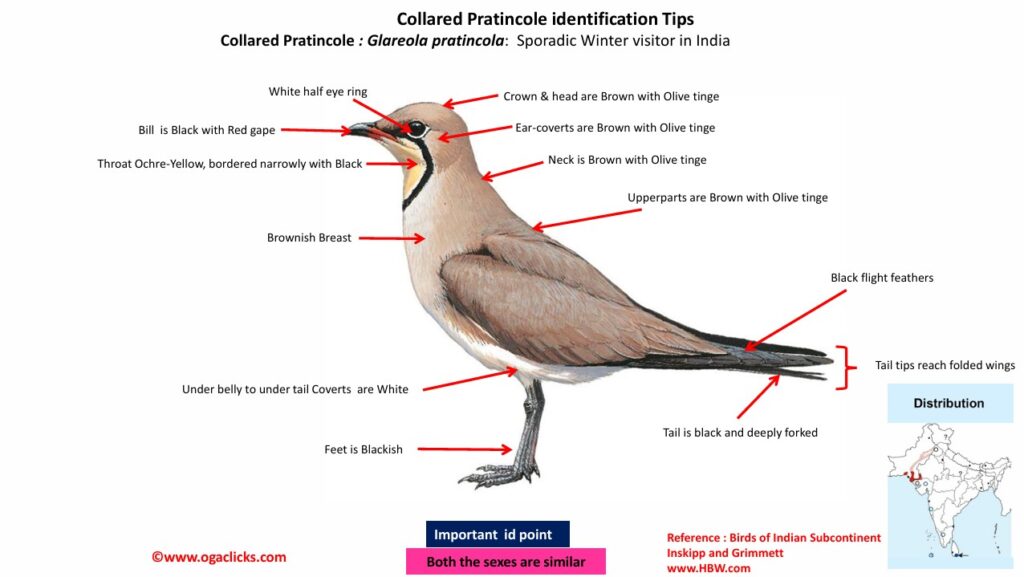
Collared Pratincole Glareola pratincola
Etymology:
- Glareola : Latin word for gravel
- Pratincola : Latin word pratum, prati –meadow; incola – inhabitant
Vernacular Names : Ben: Bada babuibatan, Guj: Tejpar, Motu thejpar, Mal: Valiya meevalkkata, Hindi: Badi Titihari, Mar: Kantheri Arli
Distribution : Winter visitor to India ( Gujarat , Maharashtra , Kerala & Ladhak)
Description: It has a size of 22–25 cm; 60–98 g; wingspan 60–70 cm. It is brown above tinged olive, with white rump; long wingtips and deeply forked black tail. The throat is ochre-yellow, bordered narrowly with black. The breast is brown shading to white belly; underwing-coverts and axillaries are deep rich chestnut. There is narrow but distinct white trailing edge to secondaries. The bill is red with black tip, legs are blackish.
In non-breeding plumage black border to throat is indistinct, lores are paler and breast is mottled grey-brown.
The juvenile is mottled with black above and on breast. The throat is whitish without black collar.
The first-winter is like non-breeding adult, but has broader pale fringes above and more streaks on head- and throat-sides.
Habitat: It is found in flat and open areas, fields, steppe plains, usually near water, sandflats, along larger rivers and estuaries. It feeds over water, rice fields or coastal scrub. It has been recorded up to 3550 m in Himalayas in Ladakh.
Food habits: It eats locusts and grasshoppers, beetles, termites, flies and other, mainly large, insects, spiders and molluscs. It forages in flocks, chiefly on the wing, catching aerial insects in graceful flight, often at dawn and dusk, sometimes on moonlit nights or where artificial light facilitates foraging. It also chases prey with fast run on ground; leaps up to catch ephydrid flies along lake shoreline above ground.
Breeding habits: They breed in May–Aug. They are colonial nester in small groups of 10–20, up to 100 pairs, on dry mudflats or sandflats; sometimes forms mixed colonies. They are seasonally monogamous. The nest is a shallow scrape or natural depression in ground such as a hoofprint, lined with dry plant fragments. Each pair defends small nesting territory within colony. They are single-brooded. They lay a clutch of three eggs. The incubation 17–19 days, done by both sexes, starting with final egg. . The young leave nest at 2–3 days. The young are fed by both parents by regurgitation or by presentation of food in bill tip, up to age of seven days old. The fledging period is 22–30 day.