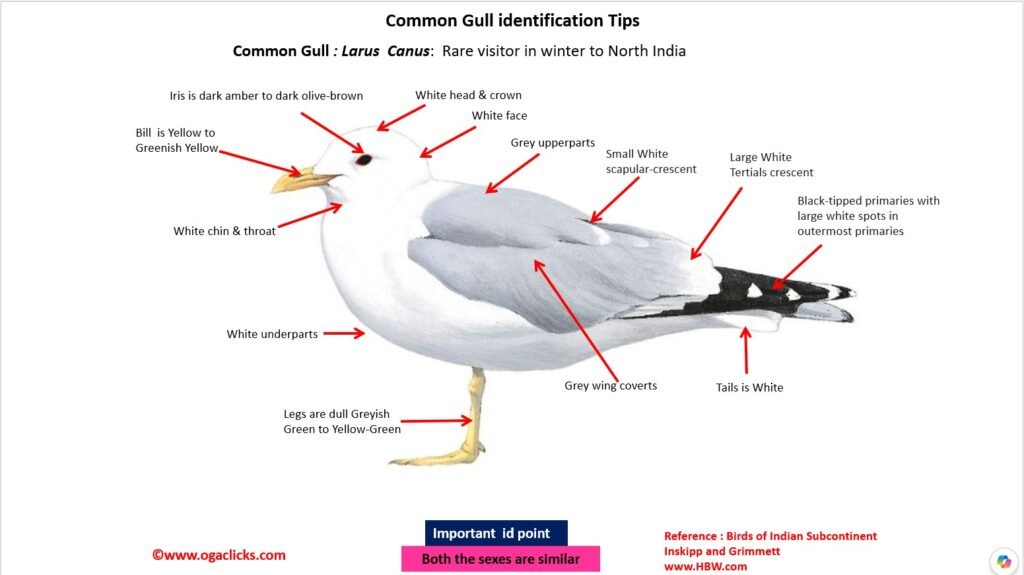
Common gull / Mew Gull Larus canus
Etymology:
- Larus : Latin word for rapacious seabird
- Canus : Latin word for Grey
Vernacular Names : Mar: Kajli Kurav
Distribution in India: Rare winter visitor in West coast of India .
Description: It has a size 40–46 cm; Race brachyrhynchus 96–102 cm.
The breeding adult has a white-headed with white body and tail, and pale grey mantle and upper wing. The upper wing has broad white trailing edge; wingtips black with large white mirrors on outer two primaries. The bill and legs are greenish yellow; iris is dark but occasional individuals with pale irides occur.
The non-breeding adult has dusky-streaked head and hindneck, and bare parts are duller; bill shows a narrow, irregular, often Z-shaped dark bar.
The juvenile is greyish brown, mottled buff, on head, breast and has unpatterned greater coverts. The mantle and scapulars are darker, with pale feather edges.
In flight shows dark outer primaries, a paler window on inner primaries and a white tail with distinct black bar. The bill is dark, legs are fleshy.
The first-winter like juvenile but paler below with a pale grey mantle; bill black-tipped with a pale pinkish or greenish base; underwing-coverts are pale, with dark tips. Second-winter resembles adult but has smaller wing mirrors and dark primary-coverts.
Race brachyrhynchus is smaller and much shorter-billed .The adult shows more white and less black on wingtips; juvenile and first-winter differ especially in having a brown tail with a heavily barred brown rump.
Habitat: It is found in coasts, tidal estuaries, agricultural land, reservoirs; breeds on coastal cliffs and islands, in beaches, bogs, marshes and meadows.
Food habits: It eats Earthworms, insects, aquatic and terrestrial invertebrates, small fish and grain It occasionally kills and eats birds and small mammals. It follows plough, feeds on new-mown fields; foot-paddles on water and on soft ground. It is found in fish-processing areas; visits rubbish dumps. it is occasionally kleptoparasitic. It also uses aerial foraging, rarely hover-gleaning; swim-dipping and surface-dipping. It drops molluscs from air onto hard surfaces. It is highly omnivorous but favours terrestrial and coastal locations when foraging, rather than the open sea.
Breeding habits: They breed in May. They breed in small colonies. The nesting substrates include grass, rock, sand, earth, floating vegetation, bogs, trees, dykes, roofs. The nest is a shallow cup of vegetation with some vegetative cover. They lay a clutch of 1–3 eggs. The incubation period is 24–26 days. The fledging period is 30–35 days.