Eurasian Sparrowhawk Accipiter nisus
Etymology:
- Accipiter : Latin word accipiter- hawk derived from accipere to grasp
- Nisus : Named after the Greek king Nisus. Mythology says he was turned into a Sparrowhawk after his daughter Scylla cut off his purple hair locks to present them to her lover Minos who was also Nisu’s Sworn enemy.
Vernacular Names: Hindi: Basha(F), Bashin(M), Pun: Chirimar, Lepcha: Tanki, Sikkim: Uchum, Guj: Badshah shakro, (F)Badshah (M) Badsheen, Ta: Valluru, Te: Warnapa dega, Mal: Prappidian, Mar: Euresiayi Chimanmar sasana
Distribution in India: Resident of Himalayas and Winter visitor to foothills of Himalayas and parts of South India.
Description: Size of 28–40 cm; weight of male is 105–196 g, female is 185–350 g ; wingspan is 56–65 cm for male and 65–78 cm for female.
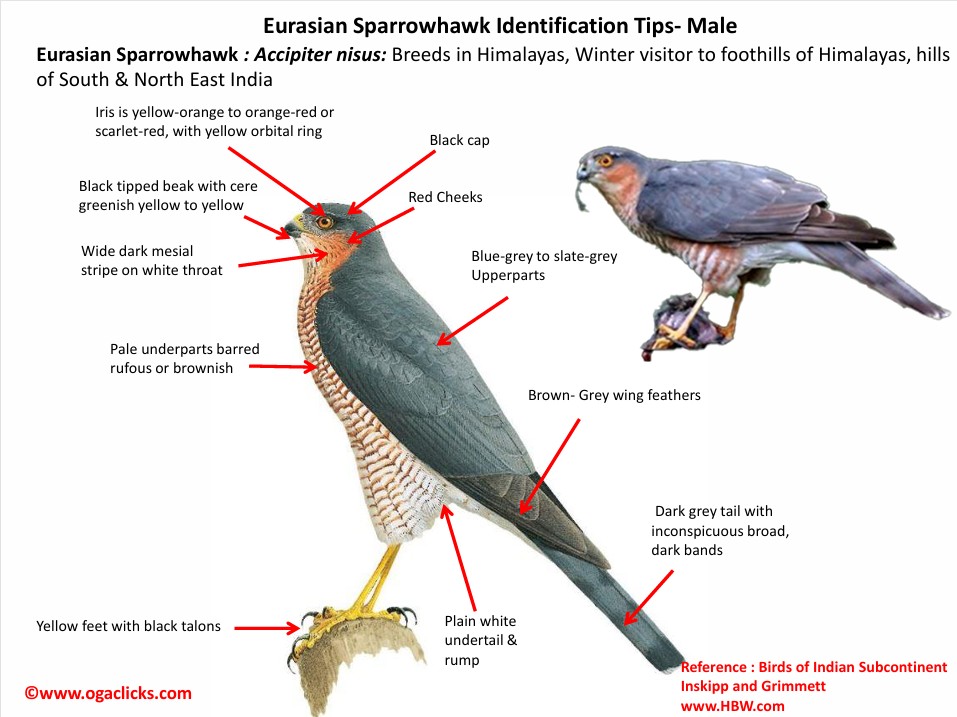
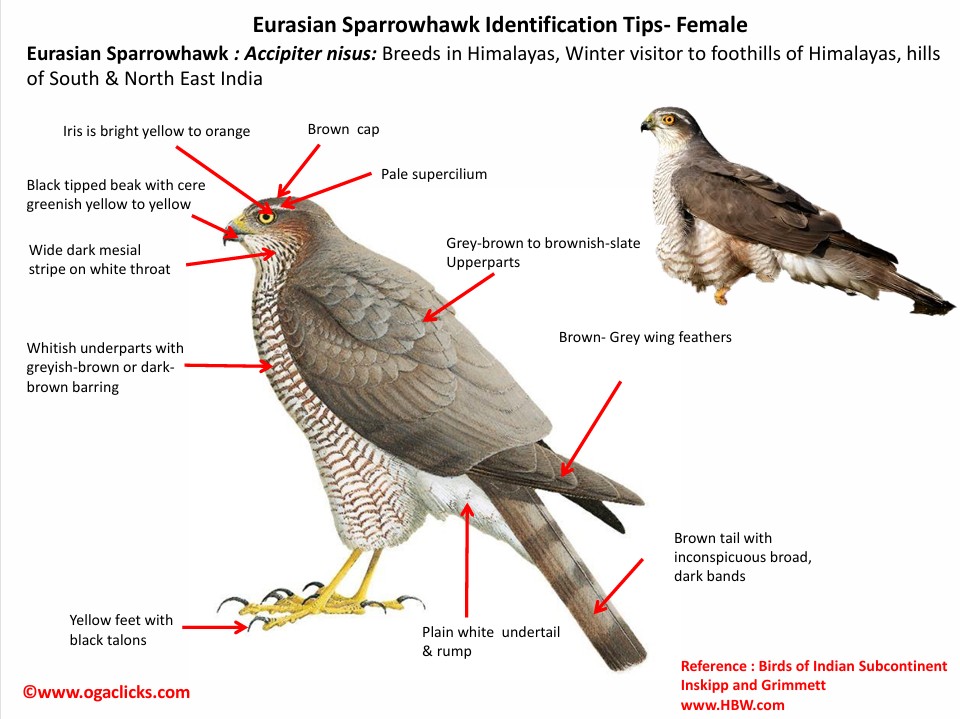
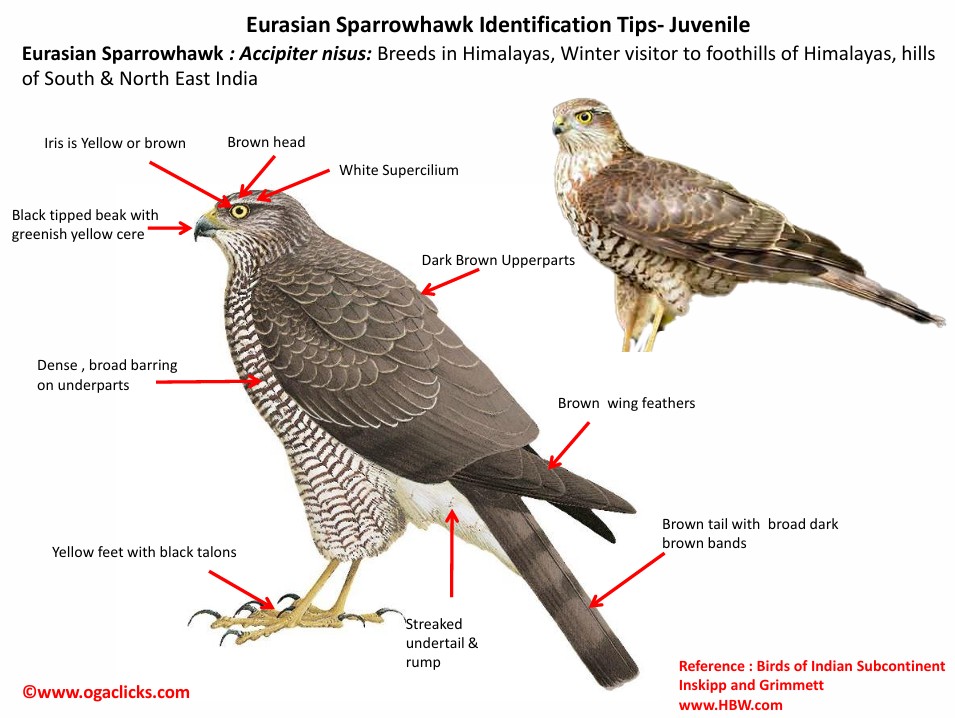
It is a smallish to medium-sized accipiter; cheeks and flanks with reddish tinge; pale underparts barred as rufous or brownish; cere is greenish-yellow to yellow; feet are yellow to orange-yellow.
The male is blue-grey to slate-grey above, whitish with rufous barring below, inconspicuous or no pale supercilium, irides are yellow-orange to orange-red or scarlet-red, with yellow orbital ring and greenish-yellow cere.
The female is larger, grey-brown to brownish-slate above, whitish with greyish-brown or dark-brown barring below, conspicuous pale supercilium, irides are bright yellow to orange.
The juvenile similar to female, but browner above with rusty feather margins and broader barring on underparts, irides are pale yellow to yellow.
Habitat: It inhabits wide variety of forest types, including coniferous, deciduous and mixtures of the two; also more open woodland; not unusual in urban and suburban parks. It is found from sea-level to 4500 m in mountains. It breeds up to tree-line and forages above it. Particularly favours mosaic of woodland or groves with more open areas. It uses broader range of habitats in winter, including areas with very few trees.
Food habits: It eats small and medium-sized birds, voles, Hares and Rabbits, Shrews, Bats, Lizards, amphibians and insects. It captures many fledglings and nestlings; breeding season timed to coincide with period of maximum availability of young of prey species. It tends to hunt in clearings, on edges of woods or in sparsely wooded area. The males hunt in more densely wooded areas than do females, and catch smaller prey on average. It hunts stealthily, trying to surprise prey; often flies using vegetation for cover, or makes short flights between concealed perches. Occasionally hunts in tandem over open habitats.
Breeding habits: They breed in Apr–Jun. They nest in woods, preferably coniferous or mixed; often near clearing to ease access to nest. The nest is built in tree, in lower crown, in fork or on branch above ground; new nest built each year by both adults. The nest is a platform of sticks with little or no greenery. They lay a clutch of 3–6 eggs . Replacement laying can occur twice in same season; The incubation period is 32–34 days done by female. The nestlings are fed by female, but prey caught nearly exclusively by male. When female begins hunting for nestlings, brings larger prey items than does male, but male continues to make the most deliveries throughout nestling.