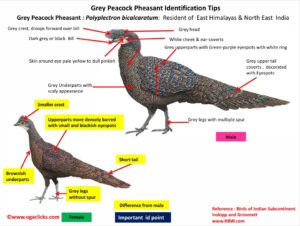
Grey Peacock Pheasant Polyplectron bicalcaratum
Etymology:
- Polyplectron : Greek word polus –many; plektron –cock’s spur
- Bicalcaratum : Latin word bi two; calcar, calcaris – spur
- Bakeri : named after British ornithologist Edward Charles Stuart Baker (1864–1944)
Distribution : Resident of Hills of NE India East from Sikkim and C & E Bhutan (West to Sunkosh Valley), East to Manipur.
Description : The male size is 56–76 cm ; tail length is 35–40 cm; weight is 568–910 g. The female size is 48–55 cm; tail length is 23–25·5 cm; weight is 460–500 g.
The male has a full crest that, when spread, droops forward over bill; each of ocelli on mantle and wings is surrounded by a white ring. The male has up to four spurs.
The Female resembles male, but lacks spurs and is smaller, with shorter crest; plumage generally darker and duller, and ocelli small and blackish, with violet reflections.
The bill and legs are dark grey or black, irides are whitish or pale grey, and bare skin around eye pale yellow to dull pinkish (exceptionally reddish in male).
The first-year male is smaller and duller than adult male, with a relatively shorter crest and ruff, blackish ocelli, a shorter tail, and has only weak spurs.
The juvenile similar to adult female, but young male has longer legs and can have larger, metallic violet ocelli after just a few weeks.
Races differ in general coloration of male, paler in Race bakeri found in India.
Habitat: It is found in evergreen and semi-evergreen forest, including areas with much bamboo It is found up to 1400 m over most of range.
Food habits: It eats berries, fruits, seeds, wild figs, grubs, ants, other insects, snails and other small animals; particularly favours termites ; bamboo seeds eaten when available, as are rice and grain from village cultivation. It forages slowly and secretively, scratching for food in quiet manner. It is found alone, in pairs, or in small family parties.
Breeding habits: They breed in Mar–Jun. The nest is located in a hollow, usually at base of bamboo clump or in thick bushes; tangles of secondary vegetation apparently favoured. They lay a clutch of 2–5 eggs. The incubation period is 21 days.