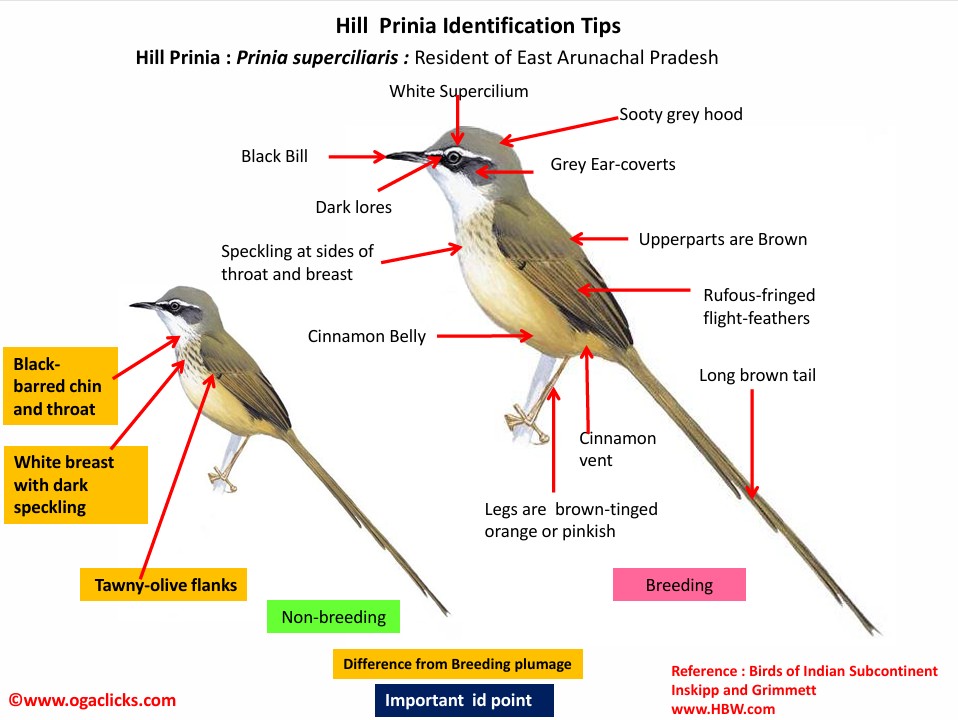
Hill Prinia Prinia superciliaris
Etymology:
- Prinia : Javanese name Prinya for the Prinia
- Superciliaris : Latin word for eyebrowed
Distribution : Resident of Northeast India (South Assam and Northeast Arunachal Pradesh)
Description : It has a size of 16–20·5 cm. It is a large Prinia with slender, slightly decurved bill and very long graduated, pointed tail. The upperparts are unstreaked, pronounced whitish supercilium.
In breeding plumage is almost olive-green above, with rufous-fringed flight-feathers, lacks white submoustachial stripe but has whitish supercilium, whitish underparts show little black, only as speckling at sides of throat and breast. In fresh non-breeding plumage may show no dark speckling at all, or it is confined to small smudges.
Both the sexes similar in plumage, male distinctly larger and relatively longer-tailed than female.
Juvenile is similar to fresh-plumaged adult, but has brown-tinged head, weaker face pattern, less distinct (or no) breast streaking and shorter tail:
Habitat: It is found in scrub, clearings, cultivated and grassy areas, and undergrowth in open, dry woodland. It is found up to 800 m in India.
Food habits: It eats insects and their larvae. They are encountered singly or in pairs, and typically very skulking, but forages also in noisy family parties of up to 5 individuals. It feeds low down among grassy or tangled vegetation; clambers up grass stalks, then dives back to ground level. It gives impression of being almost hyperactive, with tail twitched up and down and even vibrated from time to time as it works its way through clumps of vegetation. If suddenly flushed, flies low and hesitantly for short distance before diving back into cover.
Breeding habits: They breed in Mar–Jun in Northeast India. The territories are well spaced. The nest is built by both sexes. The nest is a globular construction with large side entrance, made of various grasses and flowering grass heads, mixed with small amounts of moss, usually well hidden in ground in grassy clump, loosely attached to two or three grass stems. They lay a clutch of 3–5 eggs. The incubation shared by both sexes, for a period of 10 days. Both parents also tend nestlings.