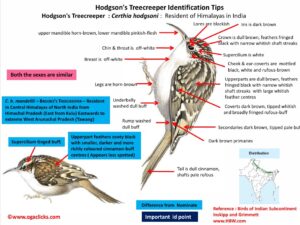
Hodgson’s Treecreeper Certhia hodgsoni
Sub Species:
- C.h. mandellii– Brooks’s Treecreeper – Resident in Central Himalayas of North India from Himachal Pradesh (East from Kulu) Eastwards to extreme West Arunachal Pradesh (Tawang)
- C.h. khamensis –Resident in North East India (in Pachakshiri region of Arunachal Pradesh)
Etymology:
- Emberiza : Old German name Embritz for a bunting
- Spodocephala: spodos ashes; kephalos -headed. { Ashy headed}
- Mandellii: Luigi Hildebrando Mandelli (1832-1880) Italian ornithologist
- Khamensis: Kham, a region of eastern Tibet and western Szechwan, China.
Distribution :
- Nominate – Resident in Kashmir and North West India (East to Lahul, in Himachal Pradesh)
- h. mandellii– Brooks’s Treecreeper – Resident in Central Himalayas of North India from Himachal Pradesh (East from Kulu) Eastwards to extreme West Arunachal Pradesh (Tawang)
- h. khamensis –Resident in North East India (in Pachakshiri region of Arunachal Pradesh)
Description: It has a size of 11–12 cm; weight of 7·6–12 g. The nominate race in fresh plumage has crown and nape as dull brown, feathers fringed black with narrow whitish shaft streaks, lores are blackish, long white supercilium from base of upper mandible to. The cheek and ear-coverts are mottled black, white and rufous-brown. The mantle and scapulars are as crown but with large whitish feather centres imparting spotted appearance. The back, rump and uppertail-coverts are cinnamon-orange with vague paler shaft streaks.
The upperwing-coverts are dark brown, lesser coverts with broad rufous-buff centres and darker tips.
The median coverts tipped whitish and broadly fringed rufous-buff, greater coverts broadly tipped off-white on outer web and fringed rufous-buff at base have fine white shaft streaks.
The alula is dark brown, broadly tipped off-white, primary coverts are dark brown, tipped buff on outer web.
The inner webs of tertials are pale grey-brown, outer webs brown, becoming black towards tip, fringed and broadly tipped pale buff.
The primaries and secondaries are medium brown, all of these except outer three primaries with broad buff band across feather, bordered on each side by black-brown band, fringed pale buff distally of these bands and broadly tipped off-white.
The tail feathers are pale brown, darker adjacent to shaft, shafts pale buff; side of neck to throat and underparts are off-white, washed dull buff on rear flanks, belly and vent, undertail-coverts are pale buff, tipped white.
In worn plumage dark feather fringes above abraded, pale streaks on crown and nape better defined, and upperparts slightly colder.
The iris is brown; upper mandible is horn-brown, lower mandible is pinkish-flesh; legs are horn-brown.
Sexes similar. The juvenile is as adult but shorter-billed, duller overall, with underparts indistinctly and finely spotted darker.
Race mandellii is darker and more rufous than nominate, upperpart feathers sooty black with smaller, darker and more richly coloured cinnamon-buff centres appearing less spotted, supercilium is tinged buff, rump rather darker and richer cinnamon-orange, and lower underparts are darker buff;
Race khamensis is poorly marked, slightly paler above, with paler and less rufous feather centres, rear flanks, vent and undertail-coverts slightly colder and greyer.
Habitat: It breeds in high-altitude coniferous woodland, often with mixture of rhododendrons (Rhododendron), birch (Betula) or occasionally oak (Quercus), sometimes in pure birch forest. In winter may descend into mixed oak-rhododendron woodland. It is found in Kashmir and North West India, from 3000 m to at least 3660 m, descending in autumn and winter to 2135 m. Found in Uttaranchal Pradesh recorded at 2590–3960 m; in Sikkim and Darjeeling generally at 2440–3660 m, in winter down to 1675 m.
Food habits: It eats arthropods. It forages on trees in typical treecreeper manner, work upwards in jerky hops, spiralling around trunk, then flies to bottom of another tree and repeats process; recorded as foraging also on moss-covered rocks. Will join mixed-species flocks.
Breeding habits: The nest has bottom lined with rhododendron bark, and pieces of rotten wood, feathers and hair, above ground. They lay a clutch of 4 eggs.