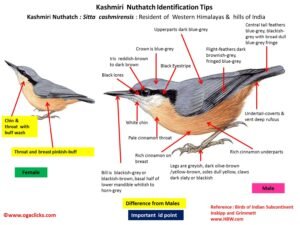
Kashmir Nuthatch Sitta cashmirensis
Etymology:
- Sitta : Greek word for a bird like a woodpecker
- Cashmirensis : From Kashmir, India
Distribution : Resident of Kashmir in India
Description: It has size of 14 cm; weight of 17·2–21 g. It is a medium-sized nuthatch, typical in shape and behaviour. The male has crown and upperparts, including upperwing-coverts and tertials are dull blue-grey. The eyestripe from extreme base of bill and lores are sooty black, extending to side of mantle, where it broadens somewhat. Alula and primary coverts are dark brownish-grey, latter fringed dull blue-grey.
The flight-feathers are dark brownish-grey, secondaries and all except outer two primaries fringed blue-grey. The central tail feathers are dull blue-grey, others blackish-grey with drab-grey at tip, pale tips progressively wider towards outermost rectrix.
The T4 with dull white spot on tip of inner web, T5 with dull white subterminal spot on inner web, T6 similar but with dull white panel on outer web mid-way along feather.
The cheek and chin are off-white, grading through pale buff on ear-coverts to buff or pale cinnamon on upper throat and side of neck, rich cinnamon on lower throat and breast, and cinnamon-rufous on side of breast, flanks and belly.
The rear flanks, vent and undertail-coverts are deep rufous, undertail-coverts with at most a trace of greyish or greyish-brown on feather centres. The thighs are dull blue-grey with darker grey feather tips; axillaries are blue-grey, finely tipped whitish, underwing-coverts are blackish-grey, tips of under primary coverts and base of flight-feathers are contrastingly white. In worn plumage upperparts are duller, but little seasonal variation in underpart coloration.
The iris is reddish-brown to dark brown; bill is blackish-grey or blackish-brown, basal half of lower mandible is whitish to horn-grey; legs are greyish, dark olive-brown or yellow-brown, soles are dull yellow, claws are dark slaty or blackish.
The female is like the male, but chin and cheek have slight buff wash, lower throat and breast are pinkish-buff, upper flanks, belly and vent are cinnamon, rear flanks is rich cinnamon.
The juvenile resembles adult but may show more pale mottling on nape (paler feather centres) and dark barring in submoustachial area (dark grey feather bases).
Habitat: It is found in Coniferous, mixed and deciduous forests. It is found at 1850–3500 m.
Food habits: It eats insects, spiders and in winter eats seeds and nuts. In summer its is found singly and in pairs & outside breeding season usually in mixed-species flocks. It forages on trunks and larger branches, usually at low levels, and often in understorey or on ground, on fallen and rotten trees and logs and moss-covered boulders.
Breeding habits: They breed in May–Jun. The nest is a layer of bark chips, seed husks and dried leaves, placed above ground in tree hole, often abandoned woodpecker hole or natural knothole, in deep forest or in well-wooded open country The nest entrance is reduced in diameter with “plaster” of wet mud (often small seeds mixed in), this sometimes forming cone-shaped short tunnel-like extension. The plaster extends for moderate distance around hole (perhaps consequence of reuse of nest from year to year and thus a build-up of material). The male assists female in nest-building and plastering. They lay a clutch of 5–7 eggs. The fledged juveniles remain with adults for 5–6 weeks after leaving nest.