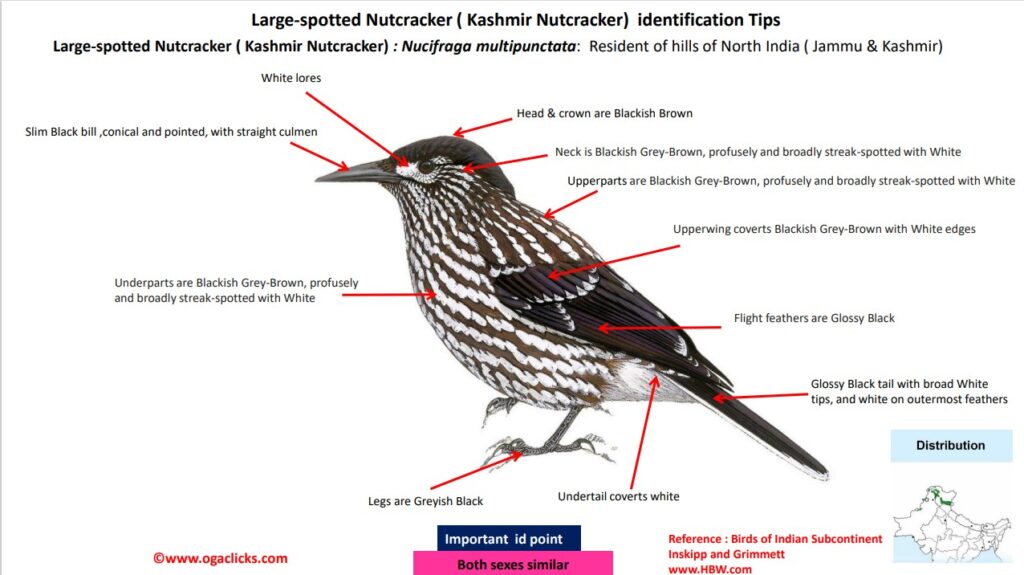
Large-spotted Nutcracker / Kashmir Nucifraga multipunctata
Etymology:
- Nucifraga : German name Nussbrecher nut-breaker. Latin word nux, nuci -s nut; frangere –to shatter.
- Multipunctata : Latin word multi– many; punctatus –spotted
Distribution: Endemic to the Northwestern Himalayas, in India the range extends west and south of the Kashmir Valley.
Description: It has a size of 32-35 cm; weight of 155–177 g.
It is a distinctive corvid with boldly spotted plumage, appearing largely whitish at long range; medium-short tail slightly rounded at corners, relatively slim bill conical and pointed, with straight culmen. The crown and nape are blackish-brown; side of head, neck and most of body plumage are blackish grey-brown, profusely and broadly streak-spotted with white. The rump and uppertail-coverts are dark brown with distinct white spots, lower belly and undertail-coverts are unmarked white. The upperwing is glossy black, white spot at tips of coverts and secondaries. The tail is glossy black, broadly tipped white on central feather pair, white becoming progressively wider towards outermost, which become white over distal two-thirds. The iris is dark brown; bill and legs are black. Both the sexes are similar.
The juvenile is similar to adult, but wings and tail dull brown & not glossy, ground colour of body plumage is lighter brown, wing-coverts with buffy-white tips, and overall impression of softer and looser plumage, particularly undertail-coverts.
Habitat: It is found in Coniferous Forest and mixed conifer and oak forest where conifers predominate, especially forests of blue pine and Morinda spruce. It is found 1000–4000 m. It is attracted by human habitation, such as villages and encampments.
Food habits: It eats Conifer seeds, and stores Walnuts and hazelnuts for winter caches. It is a specialized nut-eater, prominent ridge inside base of mandible serving as ideal nut-cracking tool. It also, holds cones and other nuts under foot and hammers at them with bill. A compulsive nut-hoarder, storing large quantities of nuts throughout winter territory, carries these in a special sublingual pouch behind the tongue, and stores them in several caches at base of tree, behind moss on rocks, crevices in tree bark, or simply on ground near small rock or sapling.
Trees depend on nutcrackers for dispersal of seeds; this form of interdependence, or mutualism, benefits both the conifer and the bird.
It employs several hunting techniques, especially when far from normal habitat during irruptions. Perches high on small tree, dropping to ground in manner of a shrike, or clings to tree trunk to dig into bark crevices in manner of woodpecker; follows ploughing tractors, clumsily catching flying ants in mid-air and hovering to get at hazelnuts; hovering over open country when searching for grasshoppers.
Has little fear of humans, especially during “invasions”; takes fish heads from fishermen’s traps, and will even enter occupied houses, or attend picnics, accepting all manner of household scraps. Forages among foliage of conifers, sweeping low from tree to tree, often flaring tail after landing. It feeds also on ground at base of conifers. Hops, walks and bounds between bouts of probing or hammering into cones.
It is found in pairs or in family parties; larger flocks, reaching up to 200 or more individuals, form during periodic irruptions.
Breeding habits: They breed in May–Jul. The nest is made of twigs, decorated with lichens, quite deep cup lined with soft roots and pine needles, placed close against trunk above ground in tall, dense conifer. They lay a clutch of 3–4 eggs.