Large-tailed Nightjar Caprimulgus macrurus
Etymology:
- Caprimulgus : Latin word capra – goat; mulgere –to milk . The nightjar were assumed to drink goats milk and injure the goats
- Macrurus : Greek word makros –long ; ouros -tailed.
-
- Albonotatus : Latin word albus – white; notatus -marked
-
- Bimaculatus : Bimaculata : Latin word bi– double; maculatus spotted
Distribution : Resident of Himalayas in East & North East India
- Albonotatus (Foothills of Himalayas from North to Bhutan and North East India, South to East India)
- Bimaculatus is distinctly darker and smaller (Extreme North East India – Nagaland and Mizoram)
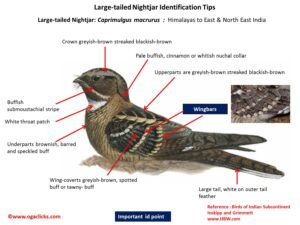
Details : Size of 25–29 cm; weight of male 54–79 g, weight of female 60–77 g. The upperparts are greyish-brown streaked blackish-brown, broadly on crown; indistinct buff or tawny-buff nuchal collar; wing-coverts are greyish-brown, spotted buff or tawny- buff, with lesser coverts darker and scapulars blackish-brown, broadly bordered buff on outer webs. It has white submoustachial stripe and large white throat patch; underparts are brownish, barred and speckled buff, becoming buff barred brown on belly and flanks. The male has large white spot on four outermost primaries and broad white tips to two outermost tail feathers. The female has buff wing spots and narrow buff or buffish-white tips to two outermost tail feathers. The Iris is dark brown, bill is blackish, legs and feet are blackish.
Races differ mainly in size and overall coloration:
Albonotatus (Foothills of Himalayas from North to Bhutan and North East India, South to East India) is the largest and palest subspecies
Bimaculatus is distinctly darker and smaller (Extreme North East India – Nagaland and Mizoram)
Habitat: It is found in deciduous forests and woods, bamboo forests and thickets, monsoon and coastal forests, edges of rainforest, secondary forest and scrub, forest clearings, forested foothills, and thick bush; also in open country, savanna, mid-montane and other grasslands, disturbed habitats, suburban gardens, villages, cultivation and coffee estates, along roadsides, by broad forest rivers or dry stream beds, near beaches, on offshore islands and river sandbanks, and in mangroves, swamps and overgrown creeks. It is found from sea-level to 2700 m.
Food habits: It eats nocturnal flying insects, moths, crickets, grasshoppers, wasps, earwigs, bugs and beetles . It forages by making flycatching sallies from perches or ground., hawks after prey or feeds on ground. It hovers near grazing livestock, preying on insects disturbed or attracted by them, and sometimes favors perches around streetlights to hunt moths attracted to the light. It is most active in periods after dusk and before dawn.
Breeding habits: They breed in Mar–May in N India. They don’t construct any nest. The eggs are laid on leaf litter, bare earth or sand. They lay a clutch of 1–2 eggs . The eggs are elliptical or oval, glossy, whitish, cream, pale pinkish-cream or salmon-buff, indistinctly blotched and spotted grey, pale purplish-brown and lavender. The eggs hatch asynchronrously, up to 3 days apart. The incubation is done mainly by the female during day and male relieves her for short time each night. The incubation period is. 16–22 days. The adults threatened at nest-site perform injury-feigning distraction display. The chicks are semi-precocial, covered in pinkish-buff down or very pale beige down , speckled and mottled blackish. They are brooded for 14 days and become independent after 35 days.