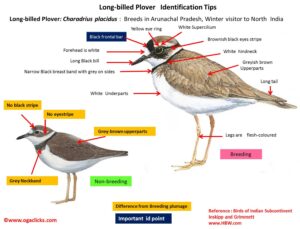
Long-billed Plover Charadrius placidus
Etymology:
- Charadrius : Greek word kharadrios for unknown plain-coloured nocturnal bird that dwelt in ravines and river valleys
- Placidus: Latin word for quite, gentle, placid
Distribution: Breeds in Arunachal Pradesh. Winters in North East India
Description : It has a size of 18–21 cm; weight of 41–70 g; wingspan of 45 cm. It has a larger, with longer dark bill and longer tail, some of which features may be more obvious in flight. It has a black breastband narrow and often has grey at sides, especially in females, and shape typically differs from other species, being broader at sides, rather than narrower.
The eyestripe is brownish black. Sexes often considered to be alike, but black frontal bar and breastband usually broader in males. The Yellow orbital ring is narrower.
The non-breeding adult has duller head and breast pattern, and brownish supercilium.
The Juvenile resembles non-breeding adult but lacks blackish on forecrown and breastband can be almost completely lacking in some. the supercilium is very pale buffy white, more ill-defined and less white and upperparts fringed with buff.
Habitat: It breeds in gravel, shingle or stony areas at edges of rivers and lakes. It breeds up to 1570 m. During non-breeding season, frequents shingle banks of large rivers and muddy areas, such as cut rice stubble fields and mudflats, but also observed on beaches and at sewage ponds. Recorded to 2700 m in Bhutan on passage
Food habits: It eats flies and beetles. Usually solitary feeder.
Breeding habits: They breed in March to July,. They lay a clutch of 3–4 eggs. The eggs are incubated by both adults for 27–29 days. The Nest is a depression, sometimes on sandy ground, among pebbles and rocks on elevated riverbank.