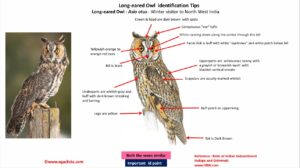
Long-eared Owl Asio otus
Etymology:
- Asio : Latin for long-eared owl
- Otus: Latin for eared Owl
Distribution in India: Winter Visitor to North West India
Description: Size of male is 35–38 cm, wt. is 220–305 g; Size of female is 37–40 cm, wt. of 260–435 g; wingspan of 90–100 cm. It is a medium-sized owl with large, round head and conspicuous ear tufts. The rounded facial disc is buff, with white inner eyebrows and lores. The upperparts are a mixture of black, brown, grey, buff and white. The wings are long and rounded, with buff patch above and dark carpal crescent below. The underparts are whitish-grey and buff with dark brown streaking and barring. The irides are yellow (in North America) or orange-yellow in (Eurasia). The bill is blackish; tarsi and toes are densely feathered. Both the sexes are similar; female is darker, especially on facial disc, more heavily streaked above, darker buff on underwing coverts. The juvenile is with facial disc, wings and tail as adult, rest of plumage is greyish-barred buff.
Habitat: In breeding season, it inhabits dense vegetation adjacent to open areas such as grassland or shrubland, including open forest. It is found from sea-level to 2750 m elevation. In winter range, occupies similar habitats to those when breeding, including farmland with hedgerows; often in traditional sites, using same tree groves annually. It roosts communally during non-breeding season
Food Habits: It eats small mammals and birds. It is nocturnal; occasionally crepuscular, usually during breeding. It hunts below canopy in open forest, but most often over open fields, pastures and shrubland. It is an active-search hunter, coursing back and forth with fast wing beats, interrupted by short glides; occasionally hovers; on rare occasions may take carrion. It is adapted for silent flight with comb-like fringe on leading edge of outer 2 primaries, soft, hair-like fringe on trailing edge of remiges, and downy surface on dorsal side of remiges. It sometimes hunts from perch, especially when windy. It locates most of prey by ear and can capture mice in complete darkness. Most of the food is captured on ground or from low vegetation. It kills small mammals by biting back of the skull. It swallows prey as a whole; may eviscerate rodents and leave entrails uneaten.
.Breeding Habits: They breed in Feb-July. They are often solitary, but with tendency to nest in small colonies during peak food years. They use abandoned stick nest of other bird, such as Magpie and Common Raven. They also accept artificial baskets, and sometimes lay in cavity in tree or cliff, atop dense mat of ivy when stick nests are scarce, or on ground. The male courtship involves zigzag flight around and through nest grove using deep wing beats interspersed with glides and wing-claps; also advertising song, which may coincide with female’s nest call. They lay a clutch of 5–7 eggs, occasionally more if food is abundant; . A replacement clutch is laid if first clutch lost. The incubation period is 26–28 days .The incubation is done by female, taking only short breaks at night. The male feeds female throughout. The hatchling hatch with eyes closed. The chicks leave nest after 21 days, still flightless, to reside in surrounding vegetation . This is called “branching” stage, where they roost apart and have high survival, suggesting that branching is adaptation to reduce predation. They are capable of flight at 35 day. The female deserts the chicks after branching stage but the male continues to feed young for 2–3 weeks longer.