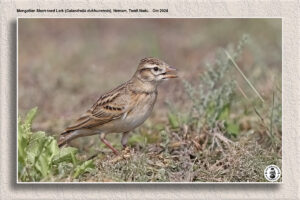
Mangolian Short-toed Lark Callendralla dukhunensis
Etymology:
- Calandrella : Greek word for Lark derived from kalandros – Calandra Lark
- Dukhunensis : From the Deccan region in India.
Distribution in India: Widespread winter visitor in West, Central and South West costal India
Description: It is a small (14–15 cm), compact lark with a fairly heavy, pointed, mainly pale pinkish bill, and long tertials that reach to or nearly to the tips of the folded wings. In adult plumage, it is heavily streaked above and mainly unmarked below except for dark patches on the side of the upper breast/lower neck.
The juvenile plumage is markedly different, being heavily pale-spotted or pale-scalloped above and having dark spots on the breast.
Both the sexes are similar.
Habitat: It is breeds on open dry sandy steppe with somewhat sparse short grass. On migration tom India it can be found in open habitats, such as stony and short-grass areas, fallow cultivation, weedy areas, stubble paddy fields, and dry mudflats
Food habits: It eats invertebrates like beetles, ants, bugs and snails. During spring, it eats seeds and green parts of plants in other seasons. The nestlings fed solely with invertebrates; and only when they fledge, they eat green material. It forages on the ground, either slowly and methodically, by pecking and occasionally by digging with its bill, or by quickly running around and stopping and pecking.
Breeding habits: Breeds in May–Jun in Mongolia. The nest is built of dried stems of plants such lined with very thin and fine dried grasses and some hairs. It lays a clutch of 2–5 eggs; replacement laid if first clutch lost. The incubation period is 10–14 days. The chicks are fed and cared for by both sexes. The nestling period is 9–12 days and, fledging period is 12–15 days and dependence period of fledglings is 1–3 weeks.