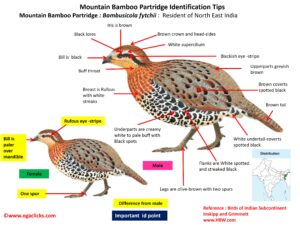
Mountain Bamboo Partridge Bambusicola fytchii
Etymology:
- Bambusicola : Latin word bambusarum of the bamboos; cola -dweller
- Fytchii : Named after British chief commissioner of Burma -Gen. Albert Fytche (1820–1892)Hopkinsoni :
- Gen. Henry Hopkinson (1820-1899) British Commissioner in Assam, India 1892
Vernacular Names: Cachar: Dao bui lai, Mani: Wakrek
Distribution : Resident of NE India (from East Arunachal Pradesh South to Meghalaya and Mizoram)
Description: It has a size of 32–37 cm; Weight of male is 278–400 g, female 256–340 g. The Male is larger than female. The male has a distinctive pattern on head and underparts; belly is creamy white to pale buff; chestnut on outer tail feathers conspicuous in flight. Male has one spur
The female usually unspurred and has rufous band behind eye.
Irides is brown to pale yellowish brown, bill blackish brown (male) to dark horn-brown becoming paler over mandible (female), and legs are olive-brown.
The Juvenile is like female, but has paler rufous crown, buffier grey upperparts and grey breast.
Race hopkinsoni found in India is larger and has buffier underparts and greyer upperparts
Habitat: It is found in scrub forest, thickets, bamboo patches, and mixed scrub and tall grassland along watercourses at 500–3000 m.
Food habits: It eats Seeds, berries, shoots and buds, rice grains and a variety of invertebrates. It scratches ground to dig food.
Breeding habits: They breed in Mar–Sept in China; May–Jul in Myanmar; Mar–May in India. The nest is a scrape on ground within scrub, bamboo or grassland, lined with grass and leaves. They lay a cluth of 4–6 eggs. The incubation period is 18–19 days done by female alone; male stays close to nest and is brings provision for the young