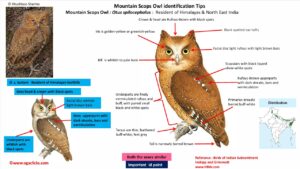
Mountain Scops Owl Otus spilocephalus
Etymology:
- Otus : Latin word for eared Owl
- Spilocephalus: Greek word spilos – spot ; kephalos -headed
Vernacular Names: Cachar: Dao hoo too
Distribution in India: Resident of Himalayas and North east India.
Description: Size of 18–20 cm; Wt. of 53–112 g . it is smallish scops-owl with highly variable plumage; some races are polymorphic. The nominate race has a facial disc that is whitish to light rufous with light brown bars, whitish eyebrows; upperparts are rufous-brown, varying from russet to dusky brown, vermiculated darker, with crown and relatively small ear tufts that are black-spotted. There is a hint of pale hindneck-collar; scapulars are with black tipped silver-white spots; remiges and tail are barred. The underparts are finely vermiculated rufous and buff, with paired small black and white spots; tarsus is completely feathered; irides are golden-yellow or greenish-yellow; bill is whitish to pale horn. The Juvenile is duller and more barred.
Habitat: It is found in dense evergreen forest, especially with chestnut, oak and rhododendron, sometimes with pine; also montane forest, gullies and ravines; locally, exploits dense regrowth at forest edge. It is found in foothills from 600–2750 m.
Food Habits: It eats moths, beetles, mantises, cicadas and other insects. It also eats small rodents and birds, and lizards. It hunts mainly beneath canopy, in lower strata of dense vegetation keeping close to the ground. It is strictly nocturnal; rarely seen by day.
Breeding Habits: They lay in Mar–Jun in Pakistan to NE India. They nest in unlined hollow in tree trunk, either natural or an abandoned woodpecker or barbet hole. They lay a clutch of 2–5 eggs.