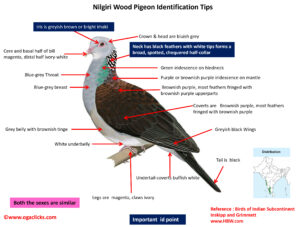
Nilgiri Wood Pigeon Columba elphinstonii
Etymology:
- Columba: Latin word for Pigeon, dove
- Elphinstonii: Named after Scottish diplomat Mountstuart Elphinstone (1779–1859)
Vernacular Name : Mal: Marapravu, Hindi: Nilgiri Jungli-kabutar, Mar: Nilgiri Ranparva
Distribution: Resident of Western Ghats
Description : It has a size of 36–42 cm; weight of 379 g. The head is bluish grey merging into darker neck and breast; the belly and undertail-coverts admixed with some brown. The hindneck has black feathers with white tips forming a broad, spotted, chequered half-colla. The green iridescence on hindneck behind collar merges into purple or brownish purple iridescence on mantle. The back, scapulars, inner wing-coverts, rump and uppertail-coverts are slate or brownish purple, most feathers fringed with brownish purple. The rest of upperparts and tail are black. The iris is greyish brown or bright khaki; cere and basal half of bill magenta, distal half ivory-white. The legs are magenta, claws are ivory.
The female is slightly duller, with purplish on upperparts reduced, and blue-grey of head admixed with brown.
The Juvenile is duller than adult with neck ornaments less developed and wing-coverts fringed with rusty reddish brown.
Habitat: It is found in moist evergreen forests from foothills up to 2000 m. The breeding usually takes place at altitudes above 1000 m.
Food habits: It eats frugivorous, feeding arboreally on fruits, berries and buds; also descends to the forest floor to take fallen berries and snails. It feeds on soil during the breeding season, probably related to calcium needs for crop-milk production.
Breeding habits: They breed in Mar–July. The nest is the typical pigeon platform of twigs. They lay a clutch of 1 white egg.