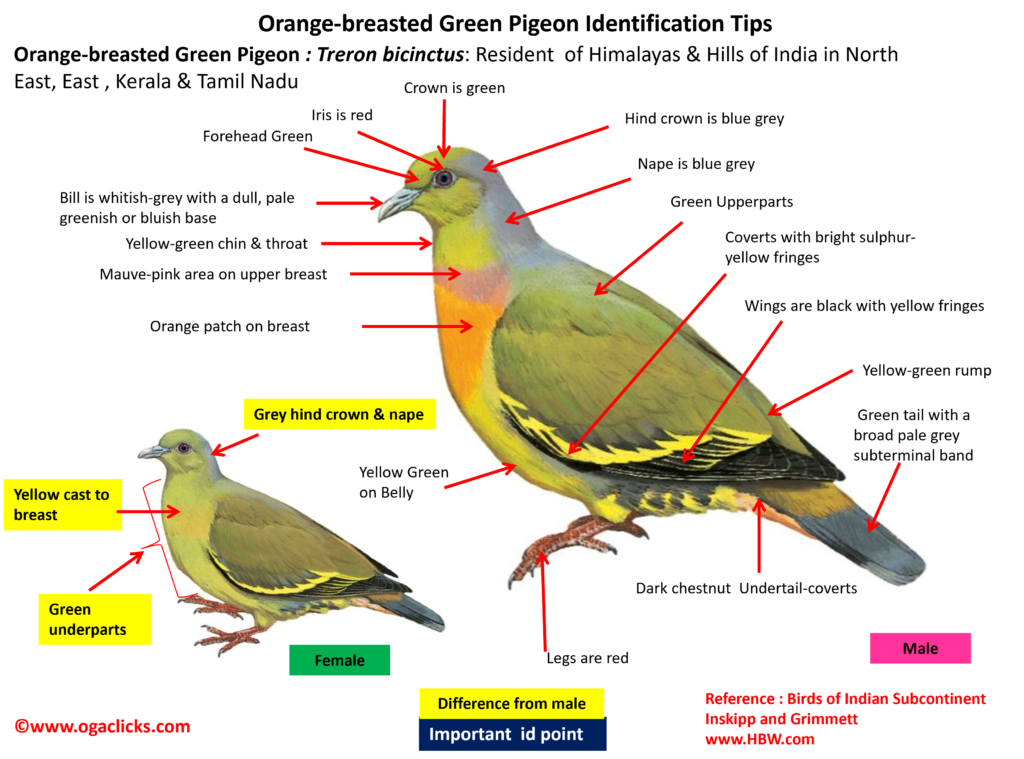
Orange-breasted Geen Pigeon Treron bicinctus
Etymology:
- Treron : Greek word for Pigeon
- Bicinctus : Ltin word bi– two-, double; cinctus – banded derived from cingere –to encircle.
Vernacular Names : Hindi: Kesari-chati Harial, Ass: Haitha, Ta: Pachchai pura, Te: Pasapu pachcha pavuramu, Mal: Manjavarayan, Sinh: Bata goya, Mar: Narangi Chatichi Haroli
Distribution : Resident in Indian Subcontinent (Himalayan foothills from Uttarakhand East to Assam, Western Ghats South of Goa, Eastern Ghats and most of East peninsula South East from Madhya Pradesh) .
Description: It has a size of 29 cm; weight of 155–194 g. It is a larger and heavier-billed green pigeon. The forehead, face and throat are greenish yellow, and mauve-pink area on upper breast smaller and does not extend to neck. The tail has, outer rectrices blackish with a broad pale grey subterminal band.
The female has grey nape and hindneck.
Habitat: It is found in forest, second growth and plantations, primarily in coastal regions, including mangroves, and lowlands, and up to 1500 m in Himalayan foothills.
Food habits: It eats fruits, taking wide variety of fruits. It is gregarious. It is found in flocks and occasionally forms mixed-species flocks.
Breeding habits: They breed in Mar–Sept. The nest is a frail platform of twigs, placed in a tree or shrub, often near a clearing, path or other opening in the forest. They lay a clutch of 2 eggs. Both parents share in nest building and incubation. The incubation period is 12–14 days.