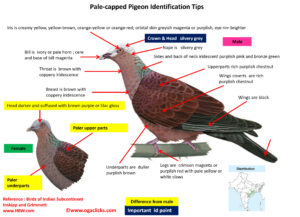
Pale-capped Pigeon Columba punicea
Etymology:
- Columba : Latin word for Pigeon, dove
- Punicea : latin word for purple
Vernacular Names: Ass: Lali pagooma, Cachar: Daohukuruma koro gophu, Hindi: Bainjani Jungli-Kabutar, Mar: Chandikvadi, Jambhala Ranparwa
Distribution: Resident of East & North East India in North Eastern Ghats, West Bengal, Assam Valley and South Assam Hills.
Description: It has a size of 36–41 cm; weight of 370–510 g. The forehead, crown and nape are silvery grey. The forehead is notably sloping in profile. The throat and neck brown have coppery iridescence merging into duller purplish brown on underparts. The sides and back of neck are iridescent purplish pink and bronze, green. The mantle, back, upper rump and most wing-coverts are rich purplish chestnut, new feathers are dark reddish chestnut fringed with iridescent purple. The lower rump is greyish black; all feathers are with green and purple iridescence. The uppertail- and undertail-coverts are dark grey. The inner secondaries and greater coverts are dusky chestnut. The primary coverts, primaries and outer secondaries are black. The tail is black; iris is creamy yellow, yellow-brown, orange-yellow or orange-red. The orbital skin is greyish magenta or purplish, eye rim is brighter; cere and base of bill are magenta, rest of bill is ivory or pale horn, The legs are crimson magenta or purplish red with pale yellow or white claws.
Female is smaller and duller; grey areas of head are darker and suffused with some brown, purple or lilac gloss.
The Juvenile is duller and browner, wing-coverts and scapulars with rufous margins.
Habitat: It is found in forest species, occurring from plains up to 1600 m. it is found in evergreen forest tracts interspersed with scrub jungle and cultivated areas, as well as in wooded ravines; also inhabits mangrove swamps in some areas.
Food habits: It eats fruits including figs. It also known to forage for seeds in fields of rice, millet, vetch and maize. Often seen as single individuals but sometimes occurs in small parties. Groups may converge on a fruiting tree or grove of seeding bamboos. It feeds in trees and on the ground.
Breeding habits: They breed in May–Aug. The nest is a flimsy structure of twigs placed low down or in a tall bush or in bamboo. They lay a Clutch of 1-2 white eggs.