Red-throated Pipit Anthus cervinus
Etymology:
- Anthus : Based on Greek mythology. Anthus, son of Antinous and Hippodamia, was killed by his father’s horses and metamorphosed into a bird which imitated the neighing of horses but fled at their sight
- Cervinus : Latin word for Stag coloured derived from cervus- stag
Vernacular Names: Hindi: Lal gala chillu, Mar: Lal Kanthachi Tirchimany
Distribution: Winter Visitor mainly to North India. Winters in Andaman Islands and sporadically in South coastal India
It has a size of 14–15 cm; weight of 16·4–29·3 g.
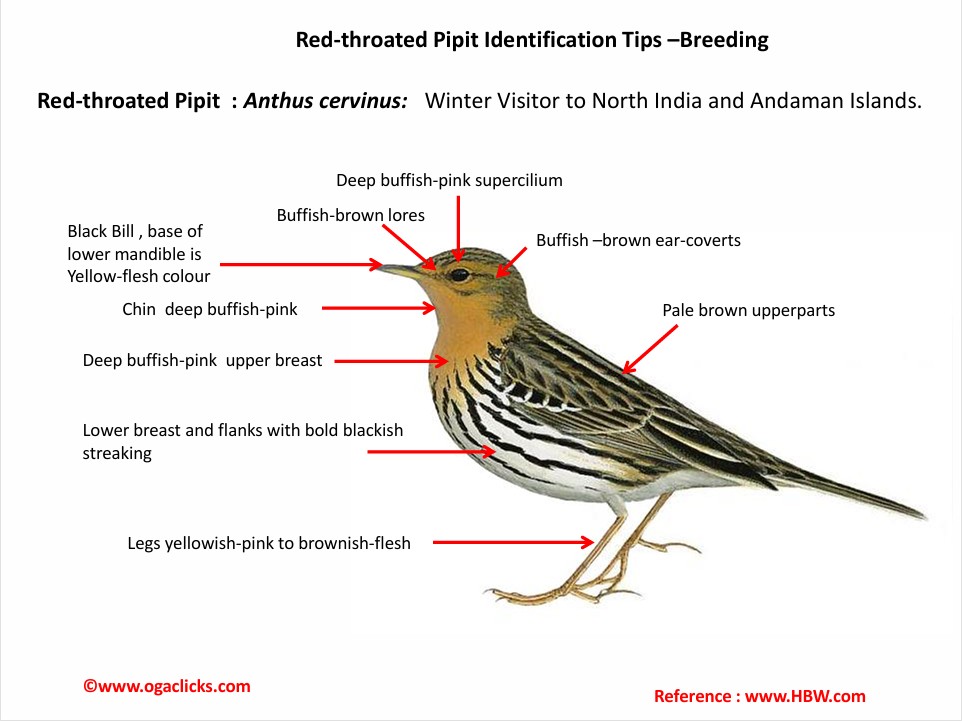
The male in breeding plumage has deep buffish-pink supercilium, buffish-brown lores and ear-coverts. The upperparts are pale brown with broad blackish-brown streaking, paler margins of mantle feathers usually forming double “V” or “braces”.
The primaries and secondaries are blackish-brown with narrow buff edgings, tertials and greater and median wing-coverts are dark brown with buffish-white tips and edges, lesser coverts are dark brown with paler brown edges.
The tail is blackish-brown, central feather pair with buff fringes, T5 with white tip on inner web, T6 with outer web and much of inner web whitish.
The chin to upper breast is deep buffish-pink, upper breast sparsely and narrowly streaked blackish. The rest of underparts are buffish-white, lower breast and flanks with bold blackish streaking. The underwing-coverts and axillaries are greyish-white. The iris is dark brown; bill is dark brown to blackish; base of lower mandible is yellowish-flesh. The legs are yellowish-pink to brownish-flesh.
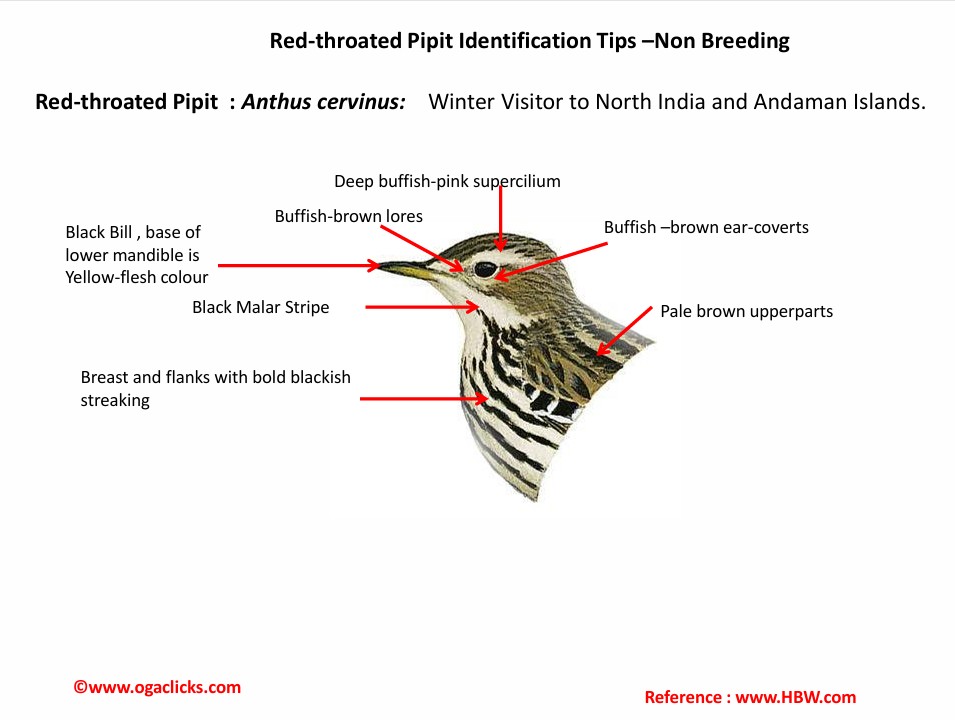
The non-breeding male has buffish supercilium and chin to chest, sometimes tinged pink, whole breast heavily streaked, and blackish malar stripe.
The breeding female has less intensive and less extensive pink on breast and head, upper breast usually buff and more heavily streaked. The non-breeding female resembles male but lacks pink tinge on supercilium and throat.
The immature has buff-white underparts and supercilium, bold black malar stripe, bold black streaking on underparts.
Habitat: It is found in breeding season in in willow mires with many small creeks, sedge marshes and peat mounds, in tundra. It winters on damp or wet short grassland, often where cattle have trampled muddy bare areas, also on marshes, and at muddy edges of rivers and other wetlands, including paddyfields and coastal flats. It is found alongside Yellow Wagtail (Motacilla flava) in non-breeding areas.
Food habits: It eats insects, also other invertebrates, and some vegetable matter. It forages on the ground, often in muddy areas, and among seaweed on seashore; adopts horizontal posture and walks quickly and wags tail often. Usually in small, loose flocks outside breeding season.
Breeding habits: They breed in May to June. In song flight, male rises, makes parachuting descent; also flutters on horizontal course, before dropping to ground. The nest is built by female; the initial hollow is made by male. Both sexes bring material but only male does so in later stages. The nest is a cup of grass leaves and stems, some moss and dead leaves at base, lined with finer grass, hair and feathers, sited on ground on hummock or bank, sometimes at end of short tunnel. They lay a clutch of 2–7 eggs. The incubation is done by female. The incubation period 11–14 days. The nestlings fed by both parents for 11–15 days.