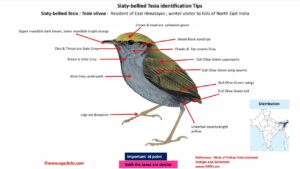
Slaty-bellied Tesia Tesia olivea
Etymology:
- Tesia : Nepalese name Tisi for Tesia
- Olivea: Latin word for Olive coloured derived from olive
Vernacular name: Lepcha: Samtit-tammong, Naga: Ting-linrui bermai-ga
Distribution : Nominate – Resident of Eastern Himalayas and Winters in North Eastern Hills of India (Assam, Arunachal Pradesh)
Description: It has a size of 9–10 cm; weight of 6–9 g. It is a small, upright and tailless ,long-legged, ground-dwelling warbler. The crown and nape are are yellowish-green, with broad dark eyestripe prominent behind eye; rest of upperparts are duller olive-green; uniformly slate-grey below;. The iris is dark; upper mandible is dark brown, lower mandible is bright orange; legs are brownish. Both the sexes are alike.
The juvenile is similar to adult but with olive-brown upperparts, greyish underparts.
Habitat: It is found in dense undergrowth of moist evergreen tropical and subtropical forests; has a preference for damp areas and sites along streams and small watercourses, also areas of ferns and nettles. It breeds at 1000–2700 m; winters at lower levels, from 1000 m down to 150 m.
Food habits: It eats invertebrates and larvae. It is active but extremely skulking, although often inquisitive and seemingly not shy. It is mostly on the ground, where it forages in or under thick undergrowth; often moves rapidly through seemingly impenetrable vegetation without any visible signs of disturbing the vegetation. It moves through decaying vegetation on ground. It has rapid bouncing gait when excited or alarmed.
Breeding habits: No Information – But considered similar to Grey Bellied Tesia (Tesia cyaniventer) {They breed in May–Jul. The nest a ball mostly of moss, placed low down, in bush, creeper or moss on side of tree. They lay a clutch 3–5 eggs}.