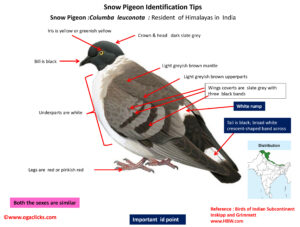
Snow Pigeon Columba leuconota
Etymology:
- Columba : Latin word for Pigeon, dove
- Leuconota : Greek word leukos white; notos -backed
Vernacular Names: Kash: Chut kotur, H.P: Bujul, Lepcha: Lho peu rentiep, Bhutia: Bya don
Distribution : Resident of Himalayas across India
Description: It has a size of 31–34 cm; weight of 255–307 g. The head is dark slate grey; neck, underparts, lower back and upper rump are white. The mantle, scapulars and lesser wing-coverts are light greyish brown, with rest of wing pale slate grey. There are three black bars across folded wing, sometimes a hint of a fourth bar. The outer webs of primaries and primary tips are black; lower rump, uppertail-coverts and tail are black. There is a broad white crescent-shaped band across tail. The iris is yellow or greenish yellow; bill is black; legs are red or pinkish red. Both the sexes are alike.
The juvenile is duller than adult, plumage is suffused with brown; grey and brown feathers have pale edges and white areas washed with greyish buff; eyes and legs dark.
Habitat: It is found in rock cliffs and steep gorges in alpine zone and also above snow-line It is found in range of 3000–5000 m.
Food habits: It eats seeds of herbs, bulbils of knotweed, bulbs of crocus, small roots and small hard seeds. It eats grain near villages in winter; ingests quartzite grit. It forages in pairs or small parties during summer and in flocks in winter gathering on boulder-strewn or grassy slopes, scree and edges of melting snow patches.
Breeding habits: They breed in May–Jul. They often breed in large colonies. It builds a skimpy nest of sticks or matted grasses and a few feathers, shaped into a platform, placed on inaccessible ledges in cliffs or rock caves. It lays a clutch of 2 eggs. The incubation period is 17–19 days.