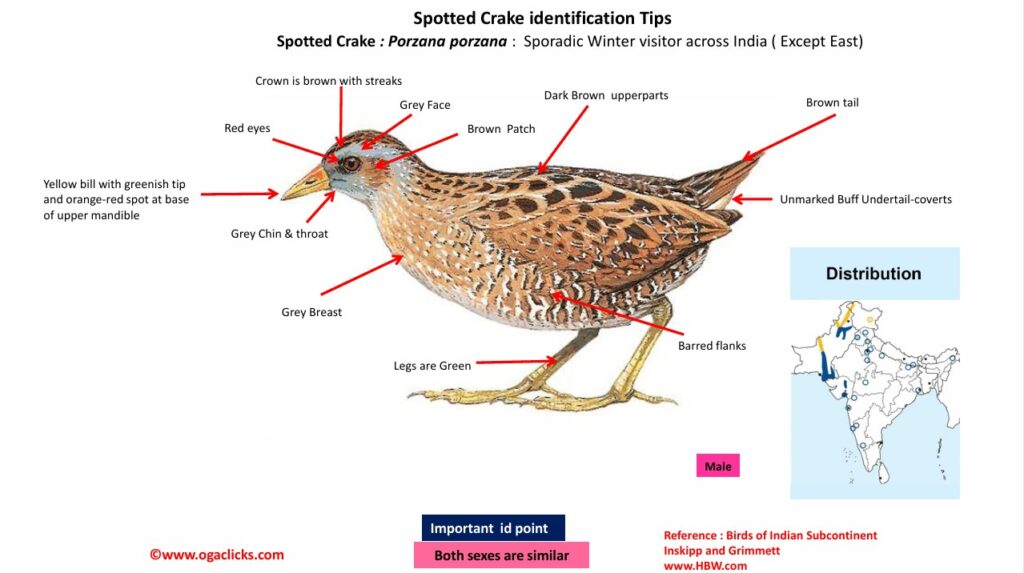
Spotted Crake Porzana porzana
Etymology:
- Porzana : Local Venetian names for smaller crakes
- Porzana : Local Venetian names for smaller crakes
Vernacular Names : Bi: Jhilli, Ben: Khairi, Gurgurri khairi, Guj: Tapkidi santa-kukadi, Ta: Venna mudi kozhi
Distribution in India: Winter visitor in India, not recorded in East India.
Description: It has a size of 22–24 cm; weight of 87·5 g; wingspan 37–42 cm. It is r plump crake, readily distinguished from others on size, structure and plumage. It has a spotted appearance, lack of extensive grey on underparts, buff undertail-coverts; yellow bill with greenish tip and orange-red spot at base of upper mandible; white leading edge to wing well visible in flight.
The male in non-breeding plumage has less grey and more spotting on face and underparts; female has less grey and more spots than male on these areas in both plumages
Both the sexes similar.
The Immature is similar to non-breeding adult but has more white spots on side of head, and narrower black margins to white markings on breast; bill changes from yellow-brown with yellow base to olive green with orange base.
The juvenile similar to immature but has streak over eye brown or cream with tiny white spots, neck is mottled grey-brown and off-white, breast is olive brown to bright brown with white or buff markings, and flanks less contrastingly barred; eye is greenish; bill is olive brown to greenish horn, darker at tip and more orange at base; legs are dull green.
Habitat: It is found in freshwater wetlands with dense cover of sedges and rushes ,grass sometimes with trees such as Acacia ; frequents areas where substrate moist, muddy or flooded. Optimum conditions found in wetlands with range of water depths or where suitable foraging areas produced by variations in water level. Occurs in marshes and fens, at sewage ponds, pools in flooded grassland, and at margins of dams, lakes and sluggish rivers. . It can occur till 2420 m.
Food habits: It is omnivorous. It eats mainly small aquatic invertebrates and parts of aquatic plants. It eats earthworms, molluscs, Arachnida, insects and their larvae and small fish stranded in drying pools. It eats plant material like algae, shoots, leaves and roots, and seeds. It forages in water and on wet to dry mud, usually keeping close to cover. It picks food from surface of substrate and immerses head in water; sometimes feeds with groups of shorebirds such as Wood Sandpipers. It walks on floating vegetation and gleans from underside of water-lily leaves; swims occasionally. It is most active early and late in the day.
Breeding habits: They breed in Apr–Jul. They are monogamous; pair-bond maintained only during breeding season. They are territorial when breeding and in winter quarters. The nest is a thick-walled cup of dead leaves and stems of available vegetation; placed in thick vegetation close to or over standing water, in tussock or built up well above water level; concealing vegetation often pulled over to form canopy. Both the sexes build the nest. They lay a clutch of 8–12 eggs , laid on alternate days. Replacements are laid after clutch loss. The incubation period is 18–19 days per egg, up to 24 days for clutch, done by both sexes. The hatching is asynchronous, taking 3 days. The chicks are fed and cared for by both parents. The chicks remain in nest until all clutch hatched, then leave in 8–10 hours. The chicks become self-feeding after several days. The fledging is up to 45 days. The bird of first breeding is after 1 year. They are usually double-brooded.