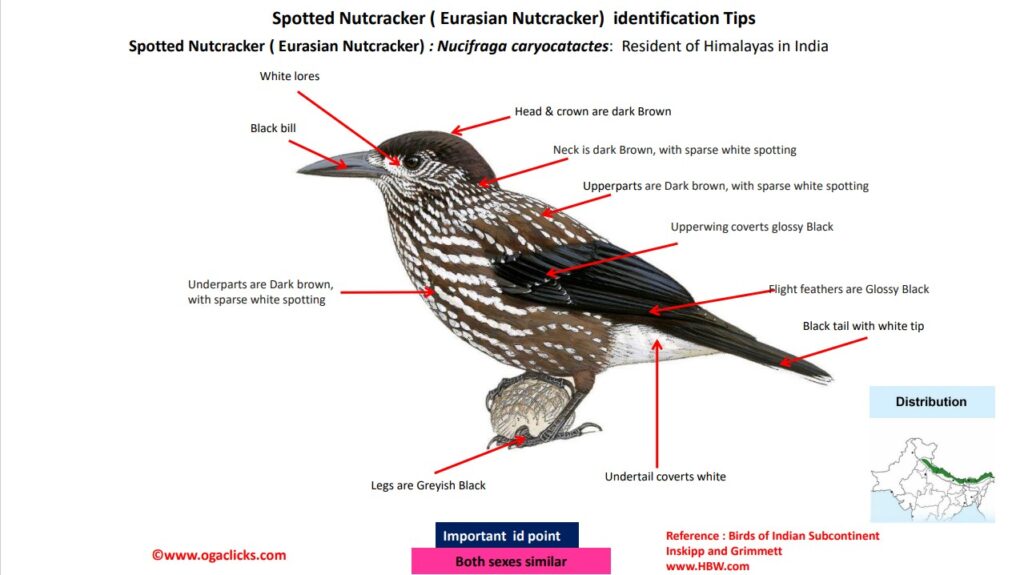
Spotted Nutcracker Nucifraga caryocatactes
Etymology:
- Nucifraga : German name Nussbrecher nut-breaker. Latin word nux, nuci -s nut; frangere –to shatter.
- Caryocatactes : Greek word karuokataktes- nutcracker derived from karuon- nut; katagnumi to shatter.
- Macrorhynchos : Greek word Macro – Large, Rhynchos – Billed {Large Billed}
Sub Species in India:
- No Nominate
- c. macrorhynchos- Resident of Himalayas
Vernacular Names : Pushtu: Khakarra, Pahari: Lek bhali, H.P.: Linmpia, Lepcha: Lho kariyo pho, Tibetan: Tong she sha ga
Distribution : Resident of Himalayas.
Description. It has a size of 32–35 cm; weight of 124–220 g; wingspan of 52–59 cm.
It is a medium-sized, rather broad-winged and short-tailed corvid with distinctively spotted plumage.
The nominate race has crown and nape very dark brown, darkest on forecrown. The sides of head, neck and most of body plumage are dark brown, profusely streak-spotted with white, most densely on sides of head giving a whitish-cheeked appearance. The spots are largest but more spaced on scapulars, breast and flanks forming confluent lines. The rump and uppertail-coverts are plain dark brown, lower belly and undertail-coverts are white. The upperwing is glossy black, coverts have tiny white spot at tip. The tail is glossy black with white feather tips, narrow on central pair, becoming progressively wider towards outermost, which look almost all white from below. The iris is dark brown; bill and legs are black. Both the sexes are similar.
The juvenile is like adult, but wings and tail are dull brown & not glossy, median coverts with broad white tip, softer and looser plumage, particularly undertail-coverts.
Subspecies differ mainly in bill shape: Race macrorhynchos differs from nominate in having broader white tailband, also the longest and slimmest bill.
Habitat: It is found in coniferous forest and mixed conifer and birch forest where conifers predominate; from lowlands of taiga up to tree limit in mountains.
Food habits: It eats pine nuts, seeds of various other conifer species, hazel nuts. During spring and early summer, it eats wide range of invertebrates, earthworms), earwigs, spiders, grasshoppers, bumblebees and wasps sometimes small rodents and small birds.
It is a specialized nut-eater, prominent ridge inside base of mandible serving as ideal nut-cracking tool. It also, holds cones and other nuts under foot and hammers at them with bill. A compulsive nut-hoarder, storing large quantities of nuts throughout winter territory, carries these in a special sublingual pouch behind the tongue, and stores them in several caches at base of tree, behind moss on rocks, crevices in tree bark, or simply on ground near small rock or sapling.
Trees depend on nutcrackers for dispersal of seeds; this form of interdependence, or mutualism, benefits both the conifer and the bird.
It employs several hunting techniques, especially when far from normal habitat during irruptions. Perches high on small tree, dropping to ground in manner of a shrike, or clings to tree trunk to dig into bark crevices in manner of woodpecker; follows ploughing tractors, clumsily catching flying ants in mid-air and hovering to get at hazelnuts; hovering over open country when searching for grasshoppers.
Has little fear of humans, especially during “invasions”; takes fish heads from fishermen’s traps, and will even enter occupied houses, or attend picnics, accepting all manner of household scraps. Forages among foliage of conifers, sweeping low from tree to tree, often flaring tail after landing. It feeds also on ground at base of conifers. Hops, walks and bounds between bouts of probing or hammering into cones.
It is found in pairs or in family parties; larger flocks, reaching up to 200 or more individuals, form during periodic irruptions.
Breeding habits: They breed in deep snow on ground in March- April. They form long-term pair-bond, partners staying together all year. They are solitary nester. The nest is built by both sexes, taking 5–12 days to complete, female doing most of lining of cup.
The nest is a mass of twigs and branches, intertwined with bramble shoots and lichens. The deep cup is lined with soft plant materials, including willow seeds, mosses and lichens, placed from ground close to main trunk of a conifer. They lay a clutch of 2–5 eggs. The incubation is done by both sexes. The incubation period is 16–18 days. The chicks are fed by both parents. The nestling period is 23 days. The young remain in family group for up to. 3 months after fledging, By July the juveniles having to establish own territory in which to hoard sufficient supplies of nuts to sustain them through forthcoming winter.