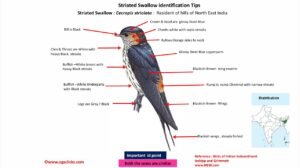
Striated Swallow Cecropis striolata
Etymology:
- Cecropis : Greek word Kekropis – Athenian woman.
- Striolata : Latin word for finely striped
Vernacular Names : Naga: Inrui gobi
Distribution : Resident of North Eastern Hills in India
Description : It has a size of 19 cm; weight of 22 g.
The nominate race has glossy steel-blue crown and back, rufous hindcollar is poorly defined or absent; rump is chestnut with narrow streaks, shorter uppertail-coverts are chestnut, longer ones black with blue gloss. The wings and tail are blackish-brown with slight blue gloss, tail is deeply forked. The cheeks are white with sepia streaks, underparts are white with heavy streaking, densest on chin and throat. The undertail-coverts are blackish-brown; underwing-coverts are white with buffy wash. Both the sexes alike.
The juvenile is duller than adult, browner above, rufous areas paler, buff tips of wing-coverts and tertials, shorter tail.
Habitat: It is found in hilly country, river gorges, forest clearings, cultivation, and human habitations. It is found up to 2560 m.
Food habits: It eats dipteran flies and cicadas. It feeds alone or in small groups, sometimes with other hirundine species. It flies slowly, low over ground or along cliff face, but sometimes very high in air.
Breeding habits: They breed in Apr–Jul. They breed as solitary or in small, loose groups. The nest is enclosed, with long tunnel, made of mud pellets, lined with dry grass and a few feathers; attached to horizontal surface on rock face, cave roof, bridge, culvert, in house close to ceiling, under eaves of building, or on verandah. The nest-construction can take several weeks. They lay a clutch of 3–5 eggs