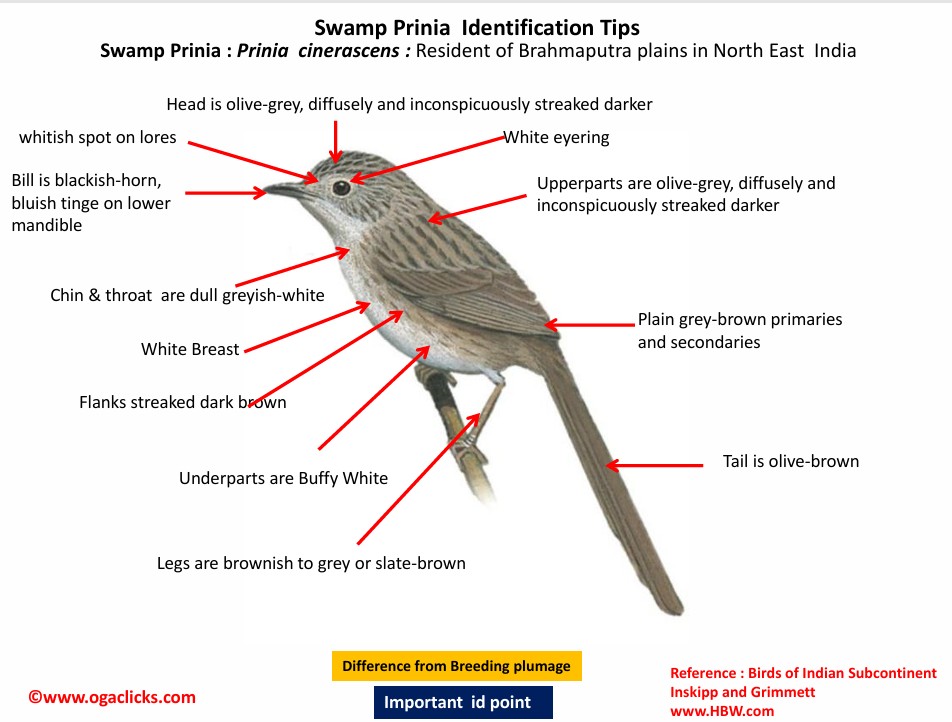
Swamp Grass Babbler ( earlier Swamp Prinia) Laticilla cinerascens
Etymology:
- Laticilla: Latin word Latus -: Wide, Broad
- Cinerascens :Latin word for Ashen
Vernacular Names : Sind: Hedela, Chiho
Distribution : Endemic to the Brahmaputra floodplain of Northeast India
Description: It has a size of 17 cm; weight of 19 g. It is a large, greyish and white, long-tailed prinia. The adult has a whitish spot on lores and narrow whitish eyering; most of head and upperparts are olive-grey, diffusely and inconspicuously streaked darker. The tail is olive-brown outermost three or four pairs have rusty-buff tips and edges soon abraded. The chin, throat and underparts are plain dull greyish-white, undertail-coverts are pale buffish-grey; iris are brown; bill is blackish-horn, bluish tinge on lower mandible. The legs are brownish to grey or slate-brown.
Both the sexes are similar in plumage, female on average a little smaller and shorter-tailed than male.
Habitat: It is found in low-lying grassy riverine plains with extensive “elephant grass” plant communities, especially in swampy conditions.
Food habits: It eats insects. It forages in pairs or in family parties, on or near ground. It keeps well-hidden low in grassy tussocks, flitting between clumps.
Breeding habits: They breed in Apr and May. The nest is a deep cup of coarse grasses, lined with finer grasses, well concealed towards base of a tuft of grasses. They lay a clutch of 4 eggs.