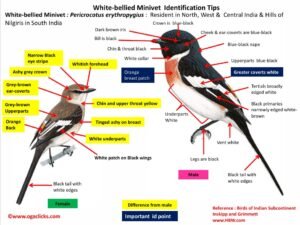
White-bellied Minivet Pericrocotus erythropygius
Etymology:
- Pericrocotus : Greek word for peri very, all around; krokotos-golden-yellow derived from krokos- saffron
- Erythropygius : Greek word eruthros – red; pugios –rumped { Red rumped}
Vernacular Names: Hindi: Safed rajalal, Safed Bulalchashm, Pun: Chitti saheli, M.P: Safed rajalal, Guj: Kabaro rajalal, Mar: Pandharya Potacha Gomet
Distribution : Resident of North , West & Central India
Description: Size of 15–16·5 cm.
It is a distinctive minivet, with plumage somewhat reminiscent of that of a stonechat (Saxicola).
The male has glossy blue-black head, mantle, back and scapulars, white rump with deep orange center, black uppertail-coverts. The upperwing is black, greater upperwing-coverts are pure white, primaries narrowly edged white-brown, tertials broadly edged white.
The tail is black, outer four feather pairs tipped white, white becoming broader outwards, outermost rectrix mostly white. The underparts including underwing-coverts are white, with orange breast patch. The iris is dark brown, bill and legs are black.
The female has black areas of male replaced by grey-brown, pale forehead and supraloral line, grey-brown ear-coverts, white throat and underparts, tinged ashy on breast and the tail as in male.
The juvenile is like female, but crown, mantle and back scaled or barred whitish, upperwing-coverts tipped white, some dark spots on side of breast.
Habitat: It is found in open, dry scrub, grassland, savanna, dry cultivation with scrub and scattered trees, hedgerows and thorn-scrub; occurs in drier areas, on rocky scrub-covered slopes, sometimes in semi-desert.
Food habits: It eats insects, including grasshoppers, also spiders. It occurs in pairs or small parties. It is less arboreal, perches on low bushes, long grass and even on the ground. It flies down to catch prey; hovers over grass and drops on to prey; gleans from leaves and weed stems; also catches insects in the air.
Breeding habits: They breed in Jun–Oct in India. The nest is built by both sexes. The nest is a small, neat cup of grass and fibers, lined with flowering grasses, bound with cobwebs and ornamented with bark or vegetable down on outside, placed above ground in vertical or horizontal fork of branch of bush or small tree. They lay a clutch of 3 eggs. Both sexes incubate and care for young.