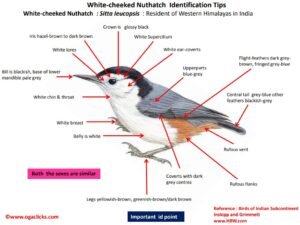
White-cheeked Nuthatch Sitta leucopsis
Etymology:
- Sitta : Greek word for a bird like a woodpecker
- Leucopsis : Greek word leukos –white; opsis – face
Distribution : Resident of West Himalayas in India
Details: Size 13 cm; weight of 13·5–15·9 g. It is a medium-sized, relatively long-billed nuthatch with distinctive combination of black cap and whitish side of head, lacking black eyestripe. The male in fresh plumage (Aug–Mar) has crown, nape and side of mantle glossy black. The upperparts, including tertials and upperwing-coverts are grey-blue, median and greater coverts with dark grey centres. The primary coverts and alula are dark grey, flight-feathers are dark grey-brown, inner primaries and secondaries are fringed grey-blue. The primaries P3-P5 are fringed grey-blue inward of emargination and very narrowly whitish distally of emargination. The central tail feathers are grey-blue as upperparts, other rectrices are blackish-grey, tipped medium grey, tips progressively broader towards outer feathers. The tail feathers T5 with small subterminal white spot on inner web, T6 with oblique white bar subterminally on inner web and narrow white fringe centrally on outer web. The lores, supercilium, ear-coverts and throat are white, faintly tinged buff. The breast, upper flanks, belly and center of vent are white, washed creamy buff, rear flanks and side of vent are rufous. The undertail-coverts are slightly paler and more orange, thighs are greyish-rufous; axillaries are pale grey, underwing-coverts are sooty black, longest under primary coverts and base of primaries are white. In the worn plumage, cap is slightly less glossy, upperparts are duller and greyer, underparts are dirty creamy with grey wash. The iris is hazel-brown to dark brown; bill is blackish, base of lower mandible is pale grey. The legs are yellowish-brown, greenish-brown or dark brown. The female is like male, but cap is less glossy and extending a little less far on to mantle. The juvenile resembles adult, but cap is duller, less clear-cut at rear, flight-feathers with slightly paler fringes and tips, cheek patch is more creamy buff, and cheeks and underparts are faintly vermiculated darker.
Habitat: It is found in coniferous forest, colder mountain valleys in dry coniferous zone and in moist temperate forest with richer mixture of broadleaf and coniferous trees. It is found from 2100m -3000m.
Food habits: It eats insects, and conifer seeds. It is found usually in pairs in spring and summer; at other times may join mixed-species foraging flocks. It forages both in upper canopy of tall trees, on trunk or small branches, and on underside of thick, lichen-draped branches. It also catches prey by flycatching.
Breeding habits: They breed in Apr to mid-Jun. They are single-brooded. In territorial display, male perches on top of tall fir, jerking body from side to side and flicking wings, calling all the while. The nest is a pad of grass and dead leaves, or a more elaborate construction of moss with fur and hair lining, placed above ground in hole or crevice in conifer, often a crack in trunk of lightning-struck tree and abandoned woodpecker excavation. They are observed to perform “bill-wiping” around nest-site but does not use mud or resin to reduce size of entrance hole. They lay a clutch of 4–8 eggs, pinkish-white, with numerous reddish and purple-grey spots concentrated at one end. The incubation is done by female. The young are fed by both sexes.