White-tailed Blue Robin Myiomela leucura
Etymology:
- Myiomela : Greek word muia – fly; melo – to take an interest in.
- Leucura : Greek word leukos – white; oura- tail
Vernacular Names : Lepcha: Mangshia
Distribution : Resident in Himalayas & North Easter Indian Hills
Description : It has a size of 17–19 cm; weight of 24–30 g.
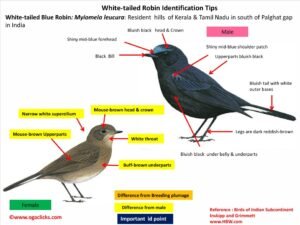
The male of nominate race is bluish black, with shiny mid-blue forehead to brow and shoulder patch, very small white neck patch (often concealed), white oval-shaped basal two-thirds of outer tail; bill and legs are black.
The female has same tail pattern as male, but mouse-brown above, buff-brown below, with indistinct white throat crescent.
The Juvenile is blackish brown with buff spotting above, buff streaking below, tail pattern as female.
Habitat: It is found in thick shady, bushy or scrubby undergrowth of dense moist broadleaf evergreen forest in lower cloud zone, often in bamboo and/or river-valley bottoms near running water. It breeds in Himalayas at 1200–2700 m, wintering from foothills to 1500 m.
Food habits: It eats Insects & berries. It forages largely on ground, but also in low underbrush, and more arboreal than Tarsiger bush-robins. It is very secretive. It constantly opens and shuts tail.
Breeding habits: They breed in Apr–Jun in India. The nest is domed or cup-shaped, made of grass and mud, placed in shrub close to ground or under rock ledge or fallen tree, or in hole in bank. They lay a clutch of 2–5 eggs.