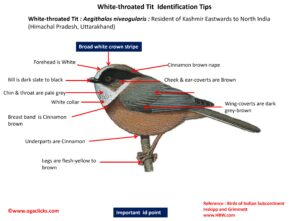
White-throated Tit Aegithalos niveogularis
Etymology:
- Aegithalos : Greek word for Tit
- Niveogularis: Latin word niveus – snow-white; gularis -throated
Distribution : Resident of Kashmir Eastwards to North India (Himachal Pradesh, Uttarakhand)
Description: Its size is 11·5 cm; weight is 7·8 g. It has forehead and broad crownstripe as white, grading to cinnamon-brown on central hindcrown and nape. The lores, cheek and side of crown are black, becoming blackish-brown on rear crown and cinnamon-brown on rear ear-coverts, and merging into nape and upper mantle. The upperparts are light grey to medium grey (washed buffish when plumage fresh), has a narrow pinkish band on rump. The greater upperwing-coverts and flight-feathers are dark grey-brown, fringed light grey, tail is dark grey-brown, feathers are edged grey, outer three pairs tipped white, outermost extensively white. The chin and throat are pale grey, submoustachial area and side of neck are purer white, clearly demarcated from narrow cinnamon-brown breastband. The remainder of underparts are beige or pale pinkish-brown. The iris is pale brown to dark brown or reddish-brown. the bill is dark slate to black. The legs are flesh-yellow to brown. Both the Sexes are alike.
The juvenile has a duller crownstripe, tinged buff on forecrown, browner upperparts, buff wash on side of neck and submoustachial, dull pinkish throat sometimes mottled darker, and narrow, irregular and less contrasting breastband.
Habitat: It is found in scrub of barberry, rose , willow, rhododendron and the likes, in and on margins of coniferous, mixed birch-spruce and oak forest. It breeds at high altitudes, towards tree-line, 2750–3965 m; In winter found at 1750–2200 m.
Food habits: It eats insects, especially insect larvae and pupae, also spiders and flower buds. It forages in shrub layer. It is found in pairs in spring and early summer; otherwise usually in small parties, up to 20 individuals together, and may join mixed-species foraging flocks.
Breeding habits: They breed in Jun in India. The nest is an oval or pear-shaped ball of moss and cobwebs, covered with lichen and densely lined with feathers, entrance to one side near top, placed in fork above ground in tree or bush or suspended in tree branches. They lay a clutch of 4 eggs.