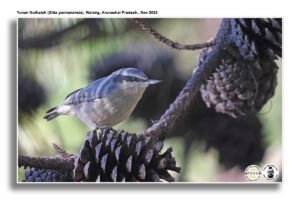
Yunan Nuthatch Sitta yunnanensis
Etymology:
- Sitta : Greek word for a bird like a woodpecker
- Yunnanensis : From Yunan province in China
Distribution : Found in Walong, Arunachal Pradesh, India
Description: It has a size of 12 cm; weight of 7·5–13 g.
It is a small nuthatch with slender, slightly upturned bill, narrow supercilium and broad long black eyestripe.
The male in fresh plumage (Aug to spring) has whitish lower forehead and narrow supercilium extending to rear of ear-coverts, black eyestripe from nostril to side of mantle, broad at rear, invaded with grey behind ear-coverts. The crown and upperparts, including tertials and upperwing-coverts are medium grey-blue, some paler feather centres visible on nape and upper mantle, inner webs of tertials greyer, grey inner webs of greater coverts fully concealed.
The alula, primary coverts and flight-feathers are dark grey-brown; smaller feathers of alula, primary coverts, inner primaries and secondaries are fringed grey-blue, primaries P3-P6 fringed pale grey-blue inward of emargination.
The central tail feathers grey-blue, other rectrices are blackish, broadly tipped blue-grey, amount of white in tail variable,
The chin, cheek, lower ear-coverts and side of neck are white forming contrasting line below dark eyestripe. The throat and underparts are clean pale pinkish-buff, flanks and vent are washed greyer, thighs are dark grey, tipped pale pinkish-buff.
The axillaries are light grey, underwing-coverts are sooty grey, longest under primary coverts and base of primaries contrastingly whitish; in worn plumage, whitish feather tips forming supercilium abraded, eyestripe broader and more prominent, upperparts are duller and less blue, wing and tail very abraded, underparts are dirty pale buff-grey or greyish-white.
The iris is dark brown, narrow white eyering; bill is grey-black, yellowish-horn base of lower mandible; legs are grey-black.
The female is like male, but eyestripe less intensely black and underparts slightly duller and greyer, less pure pale pinkish-buff.
The juvenile is duller than adult, with supercilia faint and not meeting on forehead (almost lacking), eyestripe reduced or absent, cheek patch is dirty grey-white, throat whiter, underparts dull greyish-cinnamon , bill is considerably shorter, yellowish-horn base of lower mandible more extensive.
Habitat: It is found in evergreen forest, pine forest in mixed and light deciduous forests. It is found from 2440–3960 m.
Food habits: It eats small arthropods and some seeds. It is found singly and in pairs; outside breeding season also in small loose parties, often joining mixed-species foraging flocks. It feeds on the ground, foraging over rocks and the sides of old cuttings, as well as on trees.
Breeding habits: No data