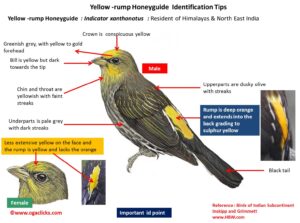
Yellow -rump Honeyguide Indicator xanthonotus
Etymology:
- Indicator : Latin word for “ guide”
- Xanthonotus : Greek word xanthos-yellow; notos -backed.
- Radcliffi : -Col. Emilius Charles Delmé-Radcliffe (1832-1907) British Army officer
Sub Species :
- Nominate – Resident of North East India
- x. radcliffii– Resident of Himalayan slopes of North West India {Plainer, greyer, yellower areas less gold and orange, and reduced, vague streaking below; perhaps on average slightly larger}
Distribution in India:
- Nominate – Resident of North East India
- x. radcliffii– Resident of Himalayan slopes of North West
Description: Size of 15–16 cm; weight of male 29–34 g, female 25–31 g. It is a Small-headed honeyguide with bright yellow in plumage. The Male of nominate race is greenish grey, with yellow to gold forehead, crown and fac. It has a conspicuous yellow or orange rump patch, white on inner webs of tertials, and broad dark ventral streaks. The tail appears all dark, square-ended.
The female has more restricted yellow, not gold or orange-gold, on head, and yellower rump than male, while mantle appears duller with more olive streaking.
The Immature (subadult) is duller, with only diffuse yellow in forehead, malar and rump, and less contrasting streaking.
Race radcliffi is plainer, greyer, yellower areas less gold and orange, and reduced, vague streaking below; average slightly larger.
The two races intergrade in Central Nepal.
Habitat: It is found in rocky, wooded gorges and streams with cliffs having colonies of giant honeybee (Apis dorsata); usually with mixed deciduous-coniferous or dry deciduous forest nearby. It is found at 600–3500 m,
Food habits: It eats Beeswax a staple food; also takes insects in flight, mostly smaller than bees. It gathers at bees’ (especially giant rock bee Apis dorsata) nests on rock-faces, eats unguarded or exposed wax, and fallen pieces. It also eats wax at abandoned nests. Groups of up to 50 may visit exposed wax source after breeding season and into autumn, but at other seasons males defend year-round resource-based territories around rock-faces with bee nests
Breeding habits: They breed in Apr–Jun.. Male sets up territory along cliff face with bees’ nests, drives off other males, but sometimes several males with territories if cliff extensive and has numerous bees’ nests (up to four may defend territories centered around 40 different hives). The male struts, raises head, flicks wings up and down, copulates with as many as 18 females. If the male is absent, others take over and breed with incoming female. The females visit more than one male, copulate with them. The territory is sometimes defended for much of year, except when birds are moulting or if numbers of young and adults seeking wax on territory become too great after breeding.