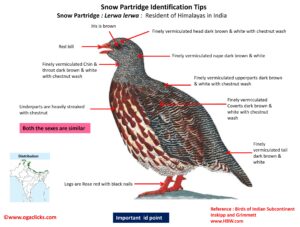
Snow Partridge Lerwa lerwa
Etymology:
- Lerwa : Bhutea name Lerwa for the Snow Partridge
- Lerwa: Bhutea name Lerwa for the Snow Partridge
Vernacular names: H.P: Biju, Barf ka titar, U.P.: Janguria, Quoir Monal, Kur monal, Bhutia: Lerwa
Distribution : Resident of Himalayas from Himanchal Pradesh to Assam & Arunachal pradesh
Descrption : It has a Size of 30–40 cm; weight of 454–709 g. It is barred dorsally than other Himalayan Galliformes, though usually just appears dark at distance. It has a bright red bill and feet; has most feathered tarsi of any Phasianidae birds.
The female is identical, but smaller than male and lacks spur while the male has two spurs. The female bill colour is pinkish or even greyish pink .
The juvenile is less strikingly marked than adult, with paler, buffy-brown underparts, finely spotted rather than barred head and neck, and upper breast finely barred rufous.
Habitat: It is found in Alpine meadows and open, rocky hillsides above treeline with scattered rhododendron bushes and grasses, ferns and lichens, and also with snow patches. It is found between 3000 m and 5500 m, up to limit of permanent snow.
Food habits: It eats Lichen, moss and other plant matter predominates. Seeds, flowers, leaves and shoots of plant are also part of the diet. It forages in pairs or small groups of up to ten individuals, but up to 20–30 birds at roosts.
Breeding habits: They breed in May to Jun in SW China. They are monogamous and territorial . The nest is a hollow, sometimes lined with moss or leaves, by rock or among alpine shrubs and usually sited on steep slope or near ridgeline. They lay a clutch of 2-5 eggs. The incubation is done by female alone. Young birds stay with parents until following breeding season