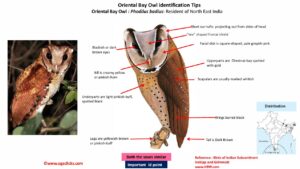
Oriental Bay Owl Phodilus badius
Etymology:
- Phodilus : Greek word phos- daylight; deilos timid,cowardly
- Badius : Latin for Chestnut-coloured, Brown
Vernacular Names: Mal: Riply moonga, Sinh: Bassa, Hindi: Purvi Bhura Ullu
Distribution in India: Resident of North East India.
Description: Size of 23–29 cm; Wt. of 255–308 g, wingspan of 207–215 mm. It is a smallish owl with rather short legs and wings and short ear-tufts projecting out from sides of head. It is chestnut-bay above, spotted with gold, wings are barred black; facial disc is square-shaped, pale greyish-pink. The underparts are light pinkish-buff, spotted with black; eyes are very large, blackish or dark brown; bill is creamy yellow or pinkish-horn, and toes are yellowish-brown or pinkish-buff. Both the sexes are alike, but female is slightly larger than male. The juvenile is like adult, but paler, with lots of short dark streaks and more heavily barred on wings and tail.
Habitat: It is found in evergreen and mixed deciduous forest, landward edge of mangroves, partially cleared land and dense foliage adjacent to cultivated land. It is found from 200m up to 2300 m elevation. It day roosts in hollow tree or in heavy cover outside of hollows or cavities.
Food Habits: It eats Small mammals like bats, rats and mice, birds, lizards, snakes, frogs and large insects. It hunts from perch, using rhythmic rocking of head to focus gaze, and pounces on prey on ground or in foliage. It is strictly nocturnal and usually hunts under forest canopy, where short, rounded wings are well suited for rapid flight amidst maze of small, vertical stems
Breeding Habits: They breed in Mar–May in India. The nest is an unlined hollow in tree trunk or rotten stump, in cavity or leaf layer in palm, and in nest box. The same site is used over many years. They lay a clutch 3–5 eggs laid at two-day intervals. The incubation starts with first egg.