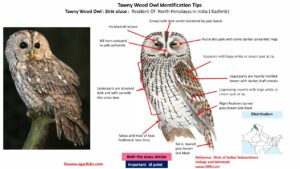
Tawny Wood Owl Strix aluco
Etymology:
- Strix : Latin word for screech owl believed to suck the blood of infants.
- Aluco : Italian name for Tawny owl
Vernacular Names : Kash: Rata mogul, Rat monglu, Lepcha: Kashi op tak pum, Bhutia: Uko
Distribution in India: Resident of Kashmir in India.
Description: Size of 37–39 cm; wingspan of 94–104 cm; male wt. of male 440 g, wt. of female 553 g . it is a medium-sized owl with noticeably stocky body, large and round head. The plumage is polymorphic, with intermediates. The nominate race is mostly grey-brown, facial disc is generally pale with some darker concentric rings, crown with dark centre bordered by pale bands; upperparts are heavily mottled brown with darker shaft streaks, outer webs of outer scapulars and upperwing-coverts are with large white or cream spot at tip. The underparts are streaked dark and with variable thin cross-bars; tarsus and most of toes are feathered; iris is blackish-brown; bill is horn-coloured to pale yellowish; toes are grey. Morphs vary mostly in ground colour of plumage, from deep rufous-brown to dark grey: rufous morph rufous-chestnut to rufous-cinnamon above, facial disc are deep rufous-cinnamon with contrasting white arcs from above each eye and from lower cheek joining at base of bill. The intermediate birds have hindneck and crown buff to pale cream-yellow with broad black streaks, remainder of upperparts are buff-brown to grey-brown with less distinct narrow dark bars and vermiculations, and facial disc is off-white with grey concentric lines. The grey morph is pale buff to grey-buff above, sometimes mixed with white on crown and hindneck; dark grey morph has plumage dominated by narrow dense black bars on crown and hindneck, dense dark grey vermiculation on rest of upperparts, and pale grey facial disc with much dark grey barring and mottling. The juvenile is paler, plumage noticeably loose, even shaggy, and more finely barred.
Habitat: It is found in open and semi-open forest, woodland, farmland with trees, parks, larger gardens in villages and towns, and tree-lined urban avenues; rocky areas with sufficient tree and bush cover. It avoids large unbroken forest tracts, wetlands and treeless plains, as well as unduly windswept, frosty or arid climates. For hunting it requires richly structured habitat with plenty of lookout posts, including sparse woodland, clearings, avenues, cemeteries, hedgerows and gardens, among mature trees, and with some preference for access to water. It is found in lowlands up to 2350 m.
Food Habits: It primarily eats small mammals like small rodents and shrews up to size of squirrels and young rabbits, and small birds up to size of pigeon; also amphibians, reptiles, earthworms, snails, beetles and other insects, occasionally fish. It is nocturnal, hunting between dusk and dawn; occasionally diurnal. The prey is typically located by sound. It hunts mostly from perch, turning body occasionally; makes frequent short flights, returning to same perch; glides or drops on to prey, extends wings on impact to cover or strike prey. Where the habitat includes open ground, it often flies slowly, with frequent intermittent glides, makes zig-zag searches, and hovers. It takes fish from water surface while in flight, or by wading in shallows. It forages for earthworms by flying down to ground and waiting motionless until it appears to hear a sound, then rotating head and stretching the neck, hopping forward, repeating head movements, and finally making 2–3 long leaps with wings partially spread to peck up worm. Bats and large insects are also seized in flight. It consumes food on elevated perch.
Breeding Habits: They breed in Feb-July. The nest is a hole in tree, also in cliff or building; often uses old nest of Eurasian Magpie or drey of squirrel. They also nest in hole in ground or among tree roots and readily accept nest box. They lay clutch of 2–9 eggs. The laying interval is 2–4 days. The female incubates and broods, and is fed by male. The incubation period is 28–30 days. Hatching is asynchronous. The young are brooded until 15 days old. Fratricide occurs when food is short. The fledging period is 32–37 days, but will leave nest at 25–30 days and hide on nearby branches.