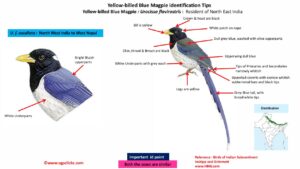
Yellow-billed Blue Magpie Urocissa flavirostris
Etymology:
- Urocissa : Greek word oura-tail; kissa-magpie
- Flavirostris: Latin word flavi- yellow ; rostrum – Beak { Yelllow billed}
Vernacular Names: H.P.: Chainchal, Kash: Lot raza, Literaz, Lepcha: Tying jongring, Sikkim: Lam puchhari, Bhutan: Pianging jabring, Te te, Hindi: Hot-rajd Mahalat
Sub Species : U. f. cucullata : North West India to West Nepal
Distribution: Resident of Himalayas and North East India
Details: Size of 55–61 cm; weight of 123–180 g. It is distinctive black-hooded, pale-billed blue-and-white magpie with very long, strongly graduated tail, central pair of rectrices projecting beyond, drooping towards tip. It is rather stout bill with curved culmen, nostrils concealed by soft plumes rather than bristles. The nominate race has head down to upper breast and upper mantle velvety black, clear whitish patch on upper nape. The upperparts are dull grey-blue, washed with olive when plumage fresh, uppertail-coverts with narrow whitish subterminal bars and black tips. The upperwing dull blue, tips of primaries and secondaries narrowly whitish clearest on tertials. The tail is grey-blue, feathers with broad white tips and black subterminal bars. The underparts below upper breast are whitish, washed lightly with grey and pale yellow. The iris is dark brown; bill and legs are yellow, light orange or rich orange. Both the sexes are similar. The juvenile is duller than adult, with dusky bill and legs, nape patch whitish and more extensive.
Races differ mainly in strength of olive and yellow tones in fresh plumage, as well as size:
U.v.cucullata (North West India to West Nepal) is smaller than nominate, blue above, purer white below. The juvenile has white on nape more extensive, from mid-crown to lower nape and, on some, even over malar region.
Habitat: It is found in moist deciduous and mixed temperate forests with oaks, chestnuts, conifers and rhododendrons, forest edge, such as clearings with settlements, with or without terraced agriculture, borders of tea plantations. It breeds above 2000 m, winters a bit lower.
Food habits: It is omnivorous, mainly carnivorous. It eats invertebrates, small vertebrates and various fruits and berries; scavenges other bird’s nests, taking both eggs and nestlings. It is found in pairs or in family-based groups. It is rather shy but can become relatively bold where food put down as offerings at temples by forest roadsides and passes. It forages at all levels, including forest floor, where it jumps about with tail raised, the very tip drooping. The group-members fly low across clearings, bounding along branches of trees and taking off one by one, finally swooping up under canopy of a tree.
Breeding habits: They breed in Apr to early Jul. They are solitary breeder with long-term pair-bond. The nest is built by both sexes, possibly with aid of a helper, made of sticks and twigs, cup lined with fine roots and plant fibres positioned above the ground in fork of long branch inside lower canopy, often in leafy sapling at edge of a clearing. They lay a clutch of 3–5 eggs. The incubation is done by female alone who is fed at nest by male. The chicks are fed by both sexes.