Abbott’s Babbler Malacocincla abbotti
Etymology :
- Malacocincla : Greek word malakos –soft; kinklos – small unidentified waterside bird.
- Abbotti: Named after British officer -Col. J. R. Abbott (1811–1888)
Distribution in India: Resident of Himalayan foothills and North East India.
Description: Size of 15–17 cm; Wt. of 26–32 g. It is a medium-sized hook-billed babbler, chunky, rather short-tailed and nondescript, brown above and greyish white to buff-tan below, with vague eyering and eyebrow. The nominate race has crown, upperparts and upperwing dull olive-brown, crown is with weak buff shaft-streaks, tail is slightly browner and with strong rufescent wash basally. The lores and supercilium are greyish, ear-coverts and neck side are buffy olive-brown, submoustachial area is buffish grey; chin, throat and upper breast are greyish-white, shading on breast side, flanks and belly are buffy rufous and on lower flanks, thighs and vent are bright rufous-buff. The iris is light brown or reddish brown; upper mandible is blackish-horn, lower mandible is paler; legs are brownish flesh. Both the sexes are similar. The juvenile has crown and upperparts dark rufescent brown.
Habitat: It is found in degraded broadleaf evergreen and semi-evergreen forest, riverine forest and swampy coastal scrub, peat swamp-forest, back edges of mangroves, palm and transitional habitats, mixed plantation-natural forest, secondary growth, forest edges along banks of streams, thickets and edge habitat. It is found from lowland up to 1100 m.
Food Habits: It eats Insects and small invertebrates. It forages solitary or in pairs, on or near ground. It forages with deliberate slow movements among leaf litter, investigating niches in low tangled vegetation; often tame.
Breeding Habits: It breeds in Apr–May in Bhutan, Jan–Sept in SE Asia, Dec–Jan on Sumatra, May–Jun in Brunei and Jul–Aug in Kalimantan. The nest is a bulky, open, sometimes deep cup, made of dead leaves, bracken fronds, weed stems, moss, grasses, black fern roots and rootlets, lined, often
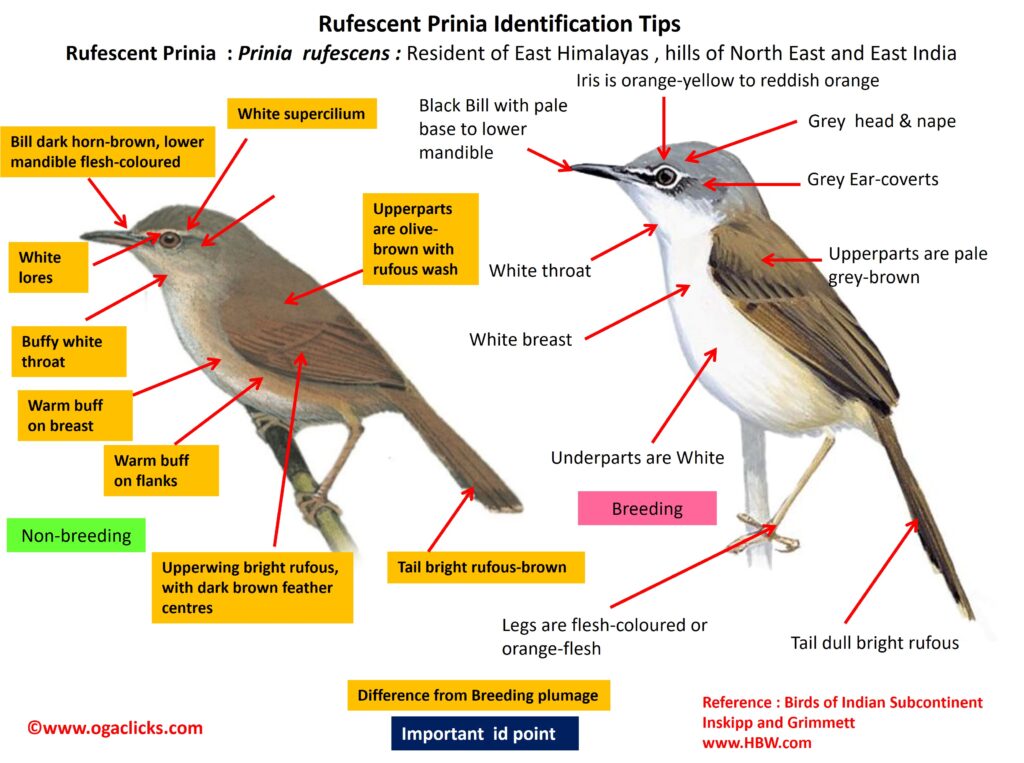
Rufescent Prinia Prinia rufescens
Etymology:
- Prinia : Javanese name Prinya for the Prinia
- Rufescens: Latin word for Reddish
Distribution : Resident from Sikkim and north West Bengal , East to Arunachal Pradesh, and from Meghalaya to Nagaland, Manipur and Mizoram; also Simlipal Hills in Odisha and Alluri Sitaramaraju Forest in north Andhra Pradesh (India)
Description: It has a size of 11–12 cm; weight of 6–7 g. It is a rather contrastingly patterned small Prinia with moderately long, graduated tail. The nominate race in fresh plumage has whitish lores, supercilium and narrow eyering, the supercilium extending to just behind eye. The crown, nape and mantle are olive-brown with rufous wash, becoming more rufous on back, rump and uppertail-coverts. The upperwing is bright rufous, with dark brown feather centres concealed when wing folded. The upperparts become less rufous and contrast with rufous wing, which abrades to reveal ginger wingpanel. The tail is bright rufous-brown, diffuse dusky subterminal mark and rufous-buff tip except on central pair of feathers. The throat and underparts are whitish, washed with warm buff on breast, flanks and undertail-coverts. The iris is reddish-brown to yellowish-brown; upper mandible is brownish-horn, lower mandible is flesh-coloured. The legs are flesh-coloured or orange-flesh.
In breeding plumage, has a greyer crown and nape, and grey cheek and ear-coverts. The tail is shorter and less bright rufous; bill is black, often with pale base to lower mandible.
Both the sexes are similar in plumage, female on average a little smaller than male.
The Juvenile is like adult, but often has pale yellow wash below, at least on lower underparts.
Habitat: It is found in grassy areas in open forest, but occupies wide range of bushy and grassy habitats, from tall grassland with scattered trees to scrubby gardens, bushy margins of terraced cultivation and tea plantations. It is found in between 500 m and 1800 m.
Food habits: It eats insects and their larvae, gleaned from leaves and on the ground. It forages in parties of up to 12–15 individuals outside breeding season; these break up at onset of breeding, then invariably found in ones and twos. It is shy; seemingly hyperactive and jumpy, flitting between bushes. Often accompanies mixed foraging parties of small forest birds, such as various small babblers.
Breeding habits: They breed in Jan–Sept. The nest is built by both sexes. The nest is a cup of grasses and fibers sewn into two or three upright leaves which form a cone. They lay a clutch of 3–4 egg. The; incubation is done by both sexes