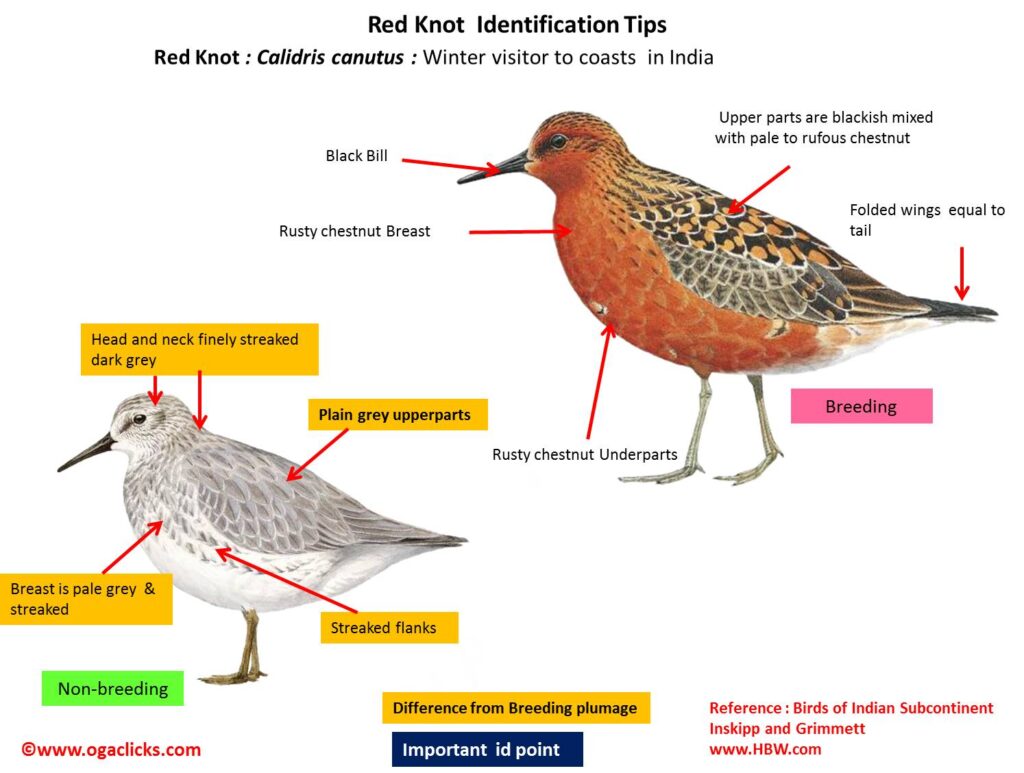
Red Knot Calidris canutus
Etymology:
- Calidris : Greek word kalidris – grey-coloured waterside bird
- Canutus : King Canute (995–1035) of England, Denmark and Norway regarded the Red Knot, suitably fattened with white bread and milk, as a delicacy
Vernacular names : Guj: Uthari kichidiyo, Ta: Maduvoo, Mar: Lal Jalaranka
Distribution in India : Winter Migrant to Costal parts of India
Description : It has a Size of 23–25 cm; weight of 85–220 g; wingspan of 45–54 cm. It has rich rusty chestnut underparts; upperparts mainly blackish mixed with pale to rufous chestnut. The female has underpart coloration broken with white feathers; more white on rear belly. The Non-breeding adult is plain grey above with narrow white fringes on larger feathers; underparts are white, with grey barring on breast and flanks. The rump is white barred grey appearing uniform grey with rest of upperparts, and white wingbar is more marked.
The Juvenile is like non-breeding adult, but breast is washed buffish, upperparts are brownish grey and wing-coverts and scapulars with buff fringes and dark subterminal bars.
Habitat: It found in high Arctic, occupying tundra and upland glacial gravel, marshy slopes and flats in foothills, close to streams or ponds, usually near coast. In non-breeding range, strictly coastal; rarely inland on migration. It prefers large tidal mudflats or sandflats; also on sandy beaches of sheltered coasts, rock shelves, bays, lagoons and harbours; occasionally on ocean beaches and saline wetlands near coast.
Food habits: It eats Insects, mainly adult and larval Diptera, also Lepidoptera, Trichoptera, beetles and bees; spiders, small crustaceans, snails and worms. It also feeds on small range of intertidal invertebrates, chiefly bivalve and gastropod molluscs, less frequent crustaceans, annelids and insects, rarely fish and seeds. It probes in soft sediment; sometimes pecks. It is highly gregarious, often in dense flocks. It is diurnal and nocturnal feeder.
Breeding habits: They breed in Jun. They are Monogamous & Solitary, territory not important for feeding. The nest is on open vegetated tundra or stone ridge, often close to clump of vegetation. They lay a clutch of 3–4 eggs, with laying interval of 1–2 days. The incubation period is 21–22 days, done by both sexes. The chick is mottled dull blackish brown above with some buff and with rows of white or cinnamon-buff tips to down, underparts white to buffish white. The females depart immediately after hatching, leaving male to tend young alone. The fledging period is 18–20 days