Slender-billed Oriole Oriolus tenuirostris
Etymology:
- Oriolus : Latin word for golden oriole derived from aureoles- golden
- Tenuirostris : Latin word tenuis- slender; rostris –billed { Slender billed}
Distribution : Resident in East Himalayas & North East India
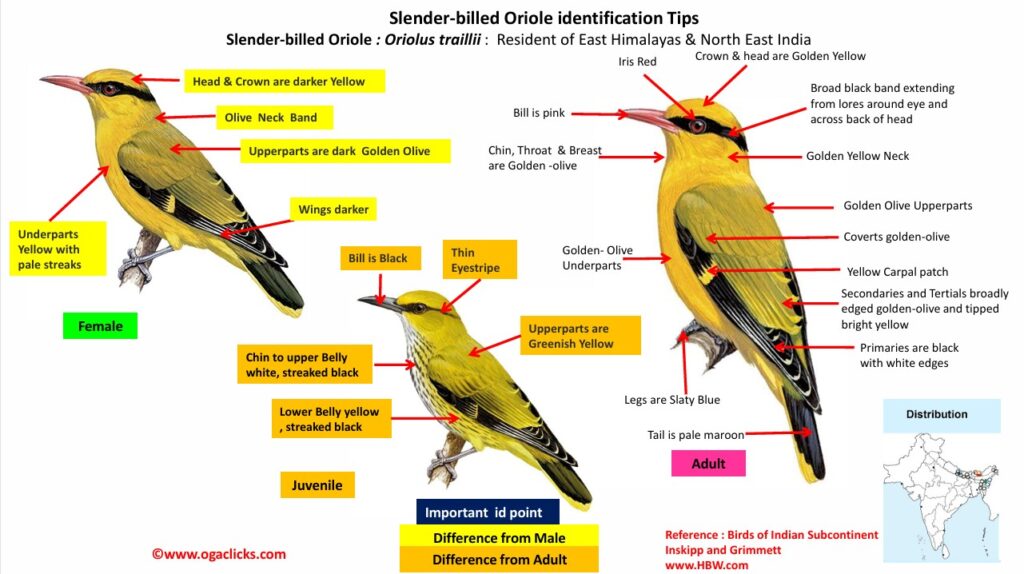
Description: It has a size of 21–25 cm; weight of 72–92 g. The Male of nominate race has head golden-yellow apart from broad black band extending from lores around eye and across back of head. The mantle and back are golden-olive, rump is duller; remiges are black, outer primaries are tipped yellowish-white and narrowly edged white, inner primaries, secondaries and tertials are broadly edged golden-olive and tipped bright yellow, upperwing-coverts are golden-olive. The tail has outermost rectrices mostly yellow and inner pair black, the intervening feathers with amount of yellow decreasing towards inner pair. The throat and underparts are entirely golden-yellow; iris is red; bill is livid pink; legs are slaty blue.
The female is very similar to male but slightly darker above, dark colour sometimes extending onto crown and obscuring nuchal band, rump is olive; yellow underparts have narrow dark streaks.
The Immature is yellowish-green above, creamy white on chest to yellowish on belly, entire underside heavily streaked black; bill black.
Habitat: It is found in montane forests, e.g. open pine forest, mixed pine-oak forest, dry open semi-evergreen or broadleaf evergreen forests, also forest edge, bamboo, plantations, gardens, groves, tea-shade trees, clearings and open country with scattered tree clumps. It is found up to to 2100 m in India. In non-breeding season it is found down to 600 m in open evergreen broadleaf forests and secondary growth.
Food habits: It eats Fruits and nectar, and insects. It forages alone or in pairs high up in trees; rarely, descends to ground to take caterpillars.
Breeding habits: They breed in Apr–Jun. The nest is a moderately deep open cup of grass stems, leaves, roots, seed down, slender strips of bark and other fine material, lined with fine grass, down, hair and feathers, suspended hammock-like from thin, horizontal forked branch at variable height, usually in outer edge of well-foliaged tree canopy, sometimes attached to creepers on oak, and often near nest of Black Drongo . They lay a clutch of 2–4 eggs