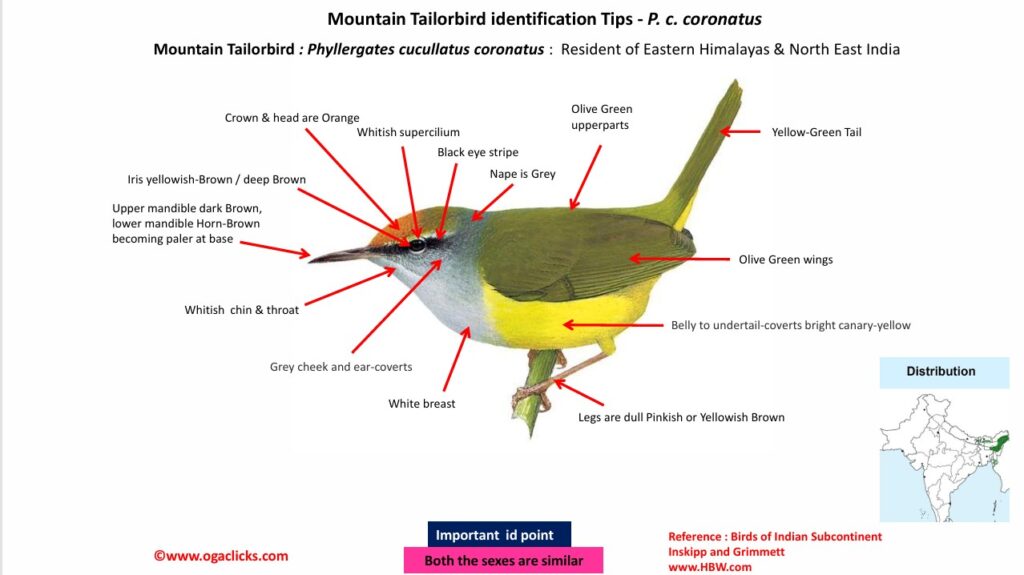
Mountain tailorbird Phyllergates cuculatus
Etymology:
- Phyllergates : Greek word phullon – leaf; ergates
- Cuculatus : Latin word for hooded derived from cucullus- hood
- Coronotus : Latin for Crowned
Vernacular Names: Naga: Inhanrui
Distribution: Resident of North East India (Darjeeling and Sikkim E to Arunachal Pradesh, also Manipur, Meghalaya and Nagaland)
Description: It has a size of 10–12 cm; weight of 6–7 g. It is a distinctive tailorbird with bright yellow lower underparts, relatively clear but short supercilium, relatively long bill slightly decurved towards tip; graduated but comparatively short tail.
The nominate race has forehead and forecrown orange, nape grey; well-marked whitish supercilium contrasting with grey cheek and ear-coverts. The upperparts are olive-green, wing browner; tail is olive-green, inner webs largely brown, outermost feather pair white on outer edge of inner webs. The throat and breast center are whitish, flanks and belly to undertail-coverts are bright canary-yellow. The iris is yellowish-brown to deep brown; upper mandible is dark brown, lower mandible is horn-brown becoming pale flesh-coloured at base; legs are brownish-flesh, paler at rear of tarsus and “soles”.
Both the sexes are similar.
The juvenile is duller than adult, with crown and nape olive, throat and breast washed pale yellowish, eyes are brown.
Races differ mainly in various aspects of plumage colour: Race Coronotus has forehead and crown are bright orange-rufous, reasonably defined yellowish supercilium yellow above eye whiter over lores and behind eye, blackish-grey eyestripe, whitish crescent under eye, yellowish wash on rump.
Habitat: It is found in bushy thickets, bamboos and hanging tangles within broadleaf evergreen forest, especially along watercourses; also tolerant of secondary growth and even found in reedbeds within forest cover. It is found in hill forest from 1000 m to 2500 m. In non-breeding season, reaching lower foothills and edge of plains in NE India (Assam).
Food habits: It eats insects& tiny invertebrates. Found typically, in pairs, or small family parties, feeding within cover. It works its way up through tangled vegetation, vines, occasionally flitting out to catch an insect in flight. It is shy and unobtrusive, easily overlooked. Cocks tail less prominently, than other tailorbirds.
Breeding habits: They breed in May–Jul in NE India. The nest is composed of fine grass stems and dry moss, lined with vegetable down, located above ground in rattan, sapling or bamboo. They lay a clutch of 3–4 eggs. Nests are parasitized by Cuckoo.