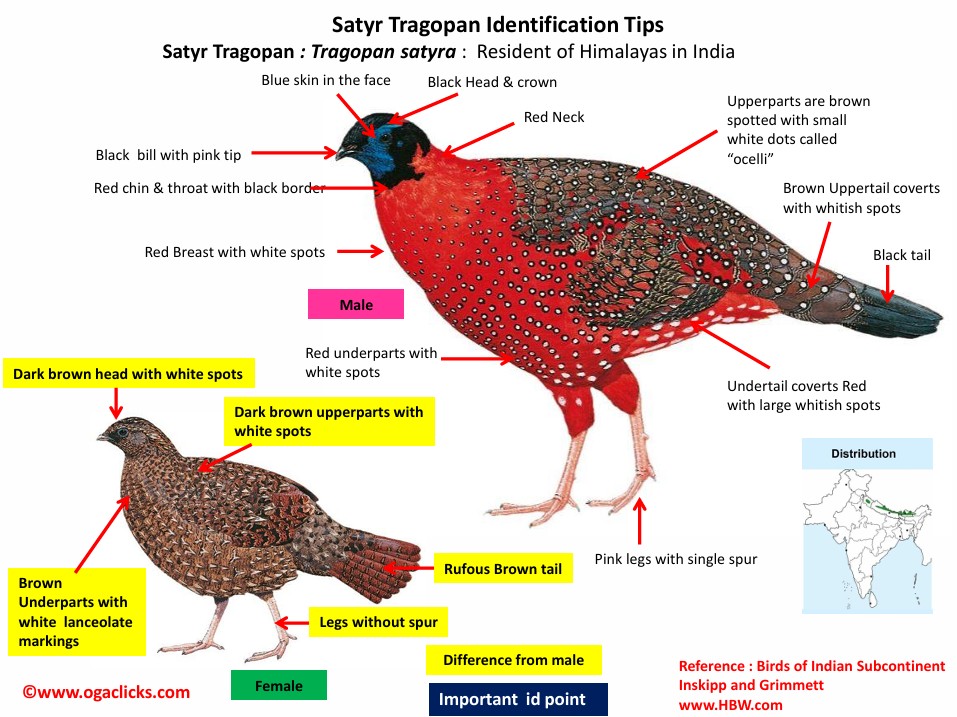
Satyr Tragopan Tragopan satyra
Etymology:
- Tragopan: Latin word for mythical, horned, purple headed bird
- Satyra: Latin word satyrus – satyr, horned sylvan deity
Vernacular Name: Hindi: Lungi, U.P.: Lungi, Lepcha: Tarrhyak, Bhutia: Omo, Bop, Nepal: Monal, Tibetan: Chamdong
Distribution: Resident of Himalayas
Description: The Size of male is 67–72 cm and tail size is 25–34·5 cm, weight of 1600–2100 g. The female size is 57·5 cm, tail size is 19·5 cm, weight of 1000–1200 g.
The male has red underparts; lower back, rump and upperwing-coverts are brown, rather than crimson.
The female is dull grey-brown to rufous, with bars and lanceolate markings; tail in particular tends to show rufous; has bluish orbital skin.
The Irides are brown, bill is black with pink tip (male) or horn-brown (female) and legs are pinkish but paler in female and non-breeding male.
The first-year male is like adult female in colour but is larger and longer-legged like adult male, with variable black on head and some red and white spotting on body.
The juvenile is very similar to female.
Habitat: It is found in broadleaf forest. It is found in damp oak, Magnolia, Rhododendron and Abies densa forests with dense undergrowth and bamboo. It is found at 2590–3800 m in summer, but down to 1800 m in winter and spring.
Food habits: It eats leaves and quartz, grass and root parts, insects, invertebrates, ants, spiders and centipedes. It usually feeds in early morning and middle to late afternoon. Feeds near small streams; forages in damp areas on moss and leaf litter and items in streams. It also feeds in trees and bushes eating the leaves, moss and fruit.
Breeding habits: They breed in Mar–Jun. They nest in long tussock grass near forest edge. They lay a clutch of 2–3 eggs. The incubation period is 28 days.