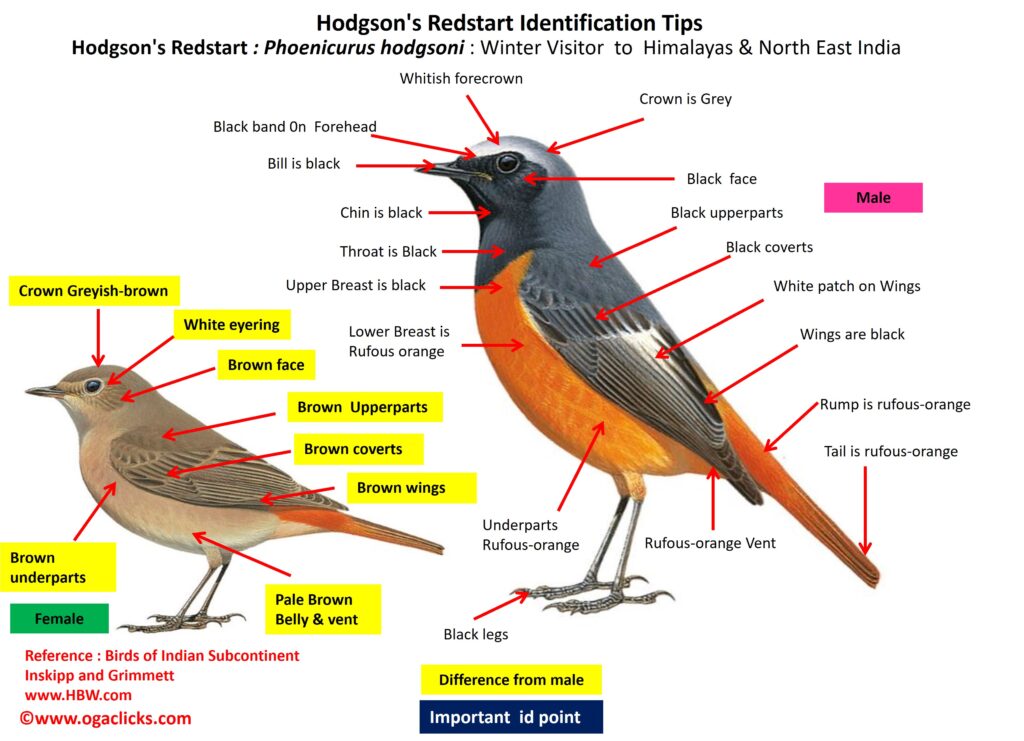
Hodgson’s Redstart Phoenicurus hodgsoni
Etymology:
- Phoenicurus : Greek word phoinix –crimson, red, purple; ouros –tailed
- Hodgsonii : Named after English diplomat Brian Houghton Hodgson (1800–1894)
Vernacular Names: Nepal: Thar-capni
Distribution: Winter Visitor in Himalayas & North East Indian Hills.
Description: It has a size of 15 cm; weight of 14–19 g.
The male has a narrower white frontal band, more extensive and slightly bluish bib extending to upper breast, more uniform and extensive rufous-orange on belly to vent, white wingpanel on secondaries.
The female has a lower back contrasting more with rump, darker and duller below.
The juvenile is like female but slightly darker and mottled below
Habitat: It is found during breeding in varied montane landscapes such as part-wooded hills, poplar-studded and pine-studded slopes, grassy bush-dotted plateaux, and scrub, grass and meadows inside mixed forest tracts in mountains, and upland valleys, often near streams and rivers, sometimes near stone houses. It is found at 2400–3600 m. In winter, it is found in partly dry riverbeds, open scrub jungle and edges of cultivation, lowlands to 2800 m.
Food habits: It eats Insects, berries. It forages in short flights from perch; also sallies for flying insects.
Breeding habits: They breed in May–Jul. The nest is made of grass stems and twigs, lined with feathers, placed in hole amid pine roots, in rotten stump, in crevice in rock, wall or riverbank, under rocks on hillside or under roof of hut. They lay a clutch of 4-5 eggs.