Chinese Vivid Niltava Niltava oatesi
Etymology:
- Niltava : Nepalese name Niltau for the Rufous-bellied Niltava
- Oatesi : Eugene William Oates (1845-1911) English civil servant
Distribution : Non breeding range is northeastern Arunachal Pradesh & southern Assam hills ( Usually seen in May -June)
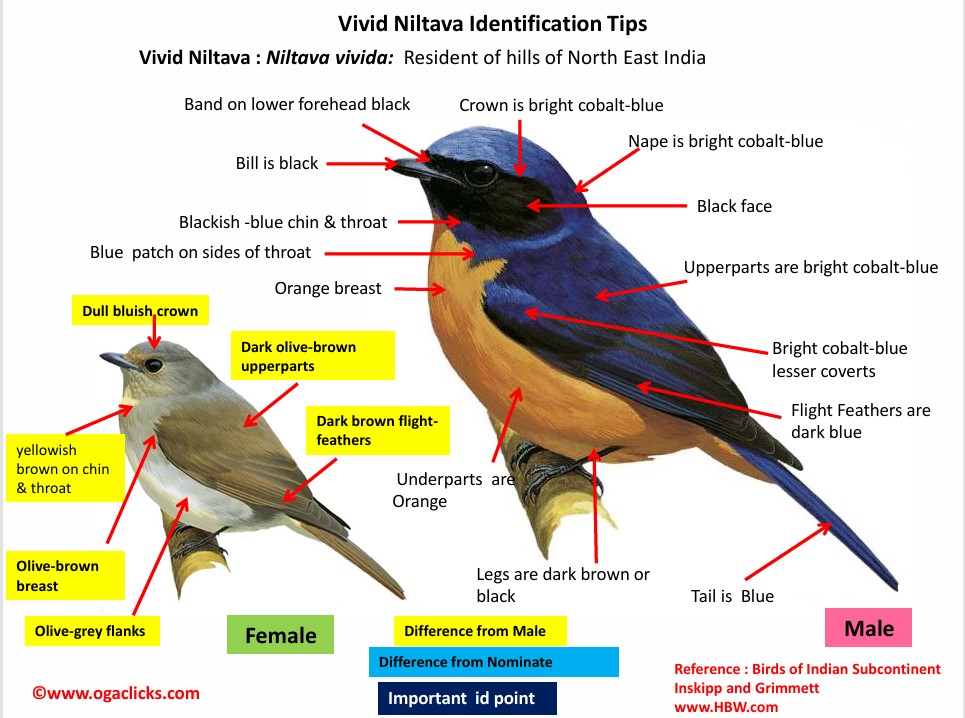
Description: It has a size of 18 cm. It is a large, long-winged Niltava with peaked crown.
The male has head to rump and uppertail-coverts, including upperwing-coverts, bright cobalt-blue. The tail is black, central feathers are cobalt-blue, all outer feathers are edged dark blue. The forehead to cheeks and ear-coverts are black. The chin and throat are blackish blue, underparts are orange-rufous with slight incursion into center of lower throat, paler or whiter on belly and flanks. The iris is dark brown; bill is black; legs are dark brown or black.
The female has head dark grey except dull bluish crown, olive-brown upperparts except darker brown wing ,buffish-edged on coverts and tail. It has a pale brown forehead and face greyer on ear-coverts, pale brown or yellowish brown on chin and throat extending to sides of upper breast, with breast olive-brow. The flanks are olive-grey and undertail-coverts pale cinnamon-brown.
The juvenile has pale eyering, is dark brown above, with buff spots on head and larger spots on mantle, back and scapulars, buff tips on rump and uppertail-coverts, pale greyish brown below, uniformly pale buff on undertail-coverts.
Habitat: It is found in temperate evergreen and mixed deciduous montane forests, in dense, dark areas of forest, breeding at up to 2600 m. It is found in non-breeding season as low as 200 m.
Food habits: It eats small invertebrates and small fruits. It is found in pairs and solitary. It forages in larger branches of middle to upper levels of forest trees; running along branches and in low brush, from which it makes aerial pursuit of flying insects.
Breeding habits: No info.