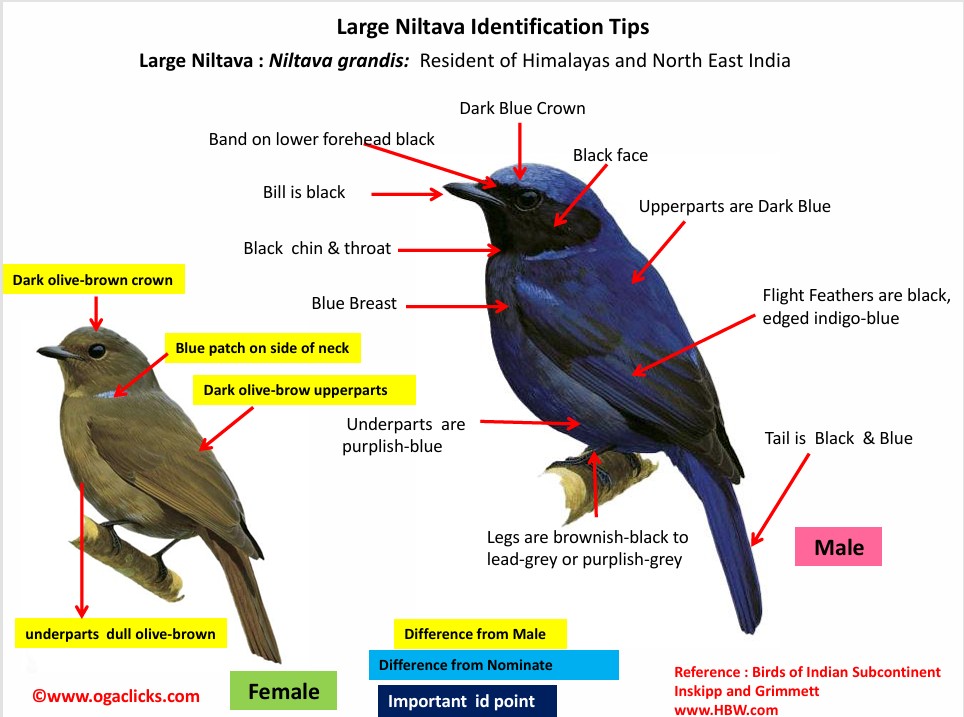
Large Niltava Niltava grandis
Etymology:
- Niltava : Nepalese name Niltau for the Rufous-bellied Niltava
- Grandis: Grandis : Latin word grandis – grand
Distribution: Resident in Himalayas from C Nepal E to NE India (Arunachal Pradesh S to Assam, Meghalaya and Manipur).
Description: It has a size of 20–22 cm; weight of 25–40 g.
It is a large forest flycatcher, the largest Asian flycatcher, stocky and fairly sluggish, with dark blue (male) or dark olive-brown (female) plumage.
The male of nominate race is almost entirely dark blue or blackish-blue, with bluer crown, neck-side patch, lesser upperwing-coverts and rump. The flight-feathers are mostly black, narrowly edged indigo-blue, tail is black, with violet-blue outer webs of outer rectrices. The face and slightly raised band on lower forehead is black. The underparts is mostly purplish-blue; iris is dark brown; bill is black; legs are brownish-black to lead-grey or purplish-grey.
The female has dark olive-brown crown and upperparts, crown is streaked bluish-grey (may show slight crest), rufous edges on upperwing-coverts, flight-feathers and rump and tail. It has rufous-buff forehead and lores, brown face finely streaked pale buff, small brilliant pale blue patch on side of neck, throat is buffish well demarcated by darker sides. The underparts are mostly dull olive-brown, streaked paler or buffish, and rich buff on flanks and undertail-coverts.
The juvenile has head and upperparts as deep rufous-brown, flecked or spotted with paler rufous-buff. The wings and tail are like adult but with pale rufous-buff tips of median and greater coverts, deep rufous-brown below, with darker brown fringes forming bars or scalloping.
Habitat: It is found in dense, mature, moist hill, submontane and montane broadleaf forests. It breeds between 1500 m and 2850 m in Himalayas. It is found at lower elevations in non-breeding season, usually between 900 m and 2000 m in foothills in Himalayas.
Food habits: It eats small to medium-sized invertebrates, and berries; large crickets and small snakes. It is solitary or in pairs; tame and approachable. It is sluggish, often spends long periods inactively on perch, may become active towards dusk. It forages in undergrowth to middle level of forest trees, often in darkest interior of forest, along trails or near streams. It also perches in the open on powerlines. It pursues insects in flight, but generally less agile in flight than are most flycatchers and often catches prey close to ground. The large prey be eaten on the ground. It flicks wings and tail and fans tail when alarmed.
Breeding habits: They breed in Feb–Jul. The nest is a bulky open or domed cup of green moss, bryophytes and plant fibers and rootlets, placed up from ground between boulders, in hole in or on tree stump, in wall, against mossy tree trunk or in creeper stems, or in recess in moss-covered bank in deeply shaded part of forest. They lay a clutch of 2–3 eggs.
.