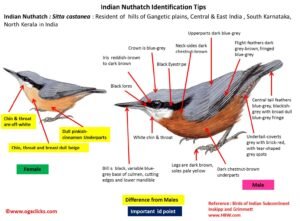
Indian Nuthatch Sitta castanea
Etymology:
- Sitta : Greek word for a bird like a woodpecker
- Castanea : Latin word for Chestnut coloured derived from castanea – chestnut
Vernacular Names : Hindi: Siri, Sans: Pitta raktodar shilindhri, Pun: Siri, Ben: Chor park/parki, Cachar: Dao-mojo-gajao, Lepcha: Sidhyi-phip, Guj: Kathaipet zad-chad, Mewadi siri, Narangipeth siri, Mar: Siri, Badami Potachi Shilindri, Te: Siri pitta, Mal: Thamraudharan gowlikkili, Maram nirangi
Hindi: Siri, Sans: Pitta raktodar shilindhri, Pun: Siri, Ben: Chor park/parki, Cachar: Dao-mojo-gajao, Lepcha: Sidhyi-phip, Guj: Kathaipet zad-chad, Mewadi siri, Narangipeth siri, Mar: Siri, Badami Potachi Shilindri, Te: Siri pitta, Mal: Thamraudharan gowlikkili, Maram nirangi
Distribution : Indian hills across North, Central and South India
Details : Size of 12·5 cm; wt of 12 g. It is a medium-small nuthatch with short, slender bill. The male has light blue-grey crown to nape and upper mantle, remainder of upperparts, including lesser and median upperwing-coverts and tertials medium are blue-grey. The extreme base of bill and lores are blackish and extending into black eyestripe which expands broadly on side of mantle, sometimes with faint paler supercilium immediately behind eye. The greater secondary coverts, primary coverts and alula are dark grey, fringed and tipped blue-grey The flight-feathers are dark grey-brown, secondaries and inner primaries are broadly fringed blue-grey, primaries P6-P3 fringed light blue-grey inward of emargination. the central tail feathers are blue-grey, others blackish-grey with broad dull blue-grey fringe on outer web and tip of inner web. The outer two feather pairs with off-white subterminal spot on inner web, T4 with small whitish tip on inner web. The chin, cheek and fore ear-coverts are white, feathers very faintly tipped darker. The rear ear-coverts, side of neck and underparts are brick-red, faintly washed orange. The undertail-coverts are blue-grey, broadly fringed brick-red, often with narrow pale creamy subterminal band . The thigh feathers are dark grey with blue-grey subterminal band and brick-red tip;. The axillaries are blue-grey, tipped brick-red, underwing-coverts are sooty black, longer under primary coverts and base of under primaries contrastingly white. In worn plumage, crown to upper mantle is paler and more contrasting, remainder of upperparts are duller blue-grey, flight-feathers are duller and browner, underparts are slightly paler and more orange. The iris is brown; bill is black, variable blue-grey base of culmen, cutting edges and lower mandible. The legs are dark brown, soles pale yellow. The female is like male but paler, chin to cheek and fore ear-coverts off-white, less well defined. The side of neck, throat and breast are dull beige, belly and vent are dull pinkish-cinnamon, rear flanks are vinaceous cinnamon, undertail-coverts are medium grey with pinkish-cinnamon fringes. The juvenile male resembles adult, but tiny pale feather centres on forehead and forecrown, feathers of crown and scapulars are variably tipped faintly darker, greater upperwing-coverts are finely tipped rufous, cheek and chin tipped faintly darker, throat slightly pale, underparts are slightly paler and more orange-brown. The juvenile female has uniform underparts, slightly duller, drabber and more orange than adult female, with less contrast between breast and belly.
Habitat: It is found in Deciduous Forest, village groves, roadside trees, sometimes gardens; in In India occurs both in plains and in hills up to 1000 m.
Food habits: It eats insects and spiders, also seeds and nuts. It is found singly, but more often in pairs or loose family parties. It frequently joins mixed-species foraging flocks. It usually forages in upper part of tall trees.
Breeding habits: They breed in Feb to May in Northern range and Apr–Sept in South. The nest is a meagre layer of dried leaves, wood chips, bark fragments or moss, usually placed in natural cavity above ground in tree. The entrance is usually reduced with a “plaster” of mud, saliva and tree resin and any damage to masonry quickly repaired. The hole may be reused in successive years. They lay a clutch of 4–5 eggs. The incubation is done by female who is fed on nest by male for a period 11–12 days.