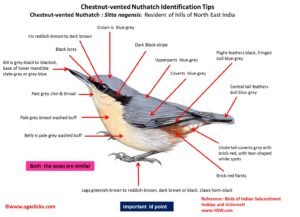
Chestnut-vented Nuthatch Sitta nagaensis
Etymology:
- Sitta : Greek word for a bird like a woodpecker
- Nagaensis : From naga hills in Burma
- Montium : Latin for Mountain -: montis
Sub Species & Distribution :
- Nominate – North East India (Patkai Range of South East Arunachal Pradesh, Nagaland, Manipur, Cachar Hills of South Assam, Khasi Hills of Meghalaya)
- n. montium- extreme North East India (North East Arunachal Pradesh)
Description : It has a size of 12·5–14 cm. It is a medium sized nuthatch, typical in shape and behaviour.
The male of nominate race has crown and upperparts as blue-grey, with prominent black eyestripe from lores to side of mantle. The lesser and median upperwing-coverts and tertials are same as back, remainder of wing is dark grey.
The greater coverts are broadly fringed and tipped dull blue-grey, primary coverts are finely fringed blue-grey, smaller feathers of alula, secondaries and inner primaries are fringed dull blue-grey.
The central tail feathers are dull blue-grey with trace of dark shaft streak, other rectrices blackish-grey with dull blue-grey tips. T3 with small white spot on tip of inner web, outer three feather pairs with larger white spot sub terminally on inner web. The outermost feather with pronounced white panel in center of outer web.
The ear-coverts and side of neck, chin, throat and underparts are very pale grey, faintly washed buff, rear flanks are strongly contrasting brick-red. The undertail-coverts are grey with brick-red sub terminally, broad white inverted triangle at tip and narrow rusty tip appearing rusty with tear-shaped white spots.
The axillaries are buff, underwing-coverts are blackish, longer under primary coverts and base of primaries are white; in worn plumage, it is duller and slightly brown-tinged above, purer grey below.
The iris is brown or dark brown; bill is grey-black to blackish, base of lower mandible slate-grey or grey-blue; legs are greenish-brown to reddish-brown, dark brown or black, claws horn-black.
Races differ mainly in tone of underside: The race montium has chin and cheek as buff-white, ear-coverts, side of neck and underparts are dull pale buff with slight grey wash, white undertail-coverts are very narrowly tipped and slightly more broadly fringed rufous and with concealed bases dull blue-grey.
Habitat: It is found in evergreen forest, pine forest in mixed and light deciduous forests. It is found from 1400–3650 m.
Food habits: It eats small arthropods and some seeds. It is found singly and in pairs; outside breeding season also in small loose parties, often joining mixed-species foraging flocks. It feeds on the ground, foraging over rocks and the sides of old cuttings, as well as on trees.
Breeding habits: They breed in Mar–Jun in NE India. The nest is a pad of scraps of bark or moss, lined with fur, placed up above ground in hole in tree or stump. The size of entrance is reduced with “plaster”. They lay a clutch of 2–5 eggs.